Daniel Kozlowski
03 Sep 2026
No Comments
Choosing a warranty management system is something that companies need to take their time with. The software will affect anything from claims processing times and dealer relations to the accuracy of the contracts and customer satisfaction. Besides, an appropriate warranty management software solution would match the company’s current processes but still allow room for improvement.
Nevertheless, a good purchasing decision begins with asking more thoughtful questions. Rather than being preoccupied with features, companies should be concerned with how a certain platform deals with claims, contracts, integration, automation, reporting, and scaling.
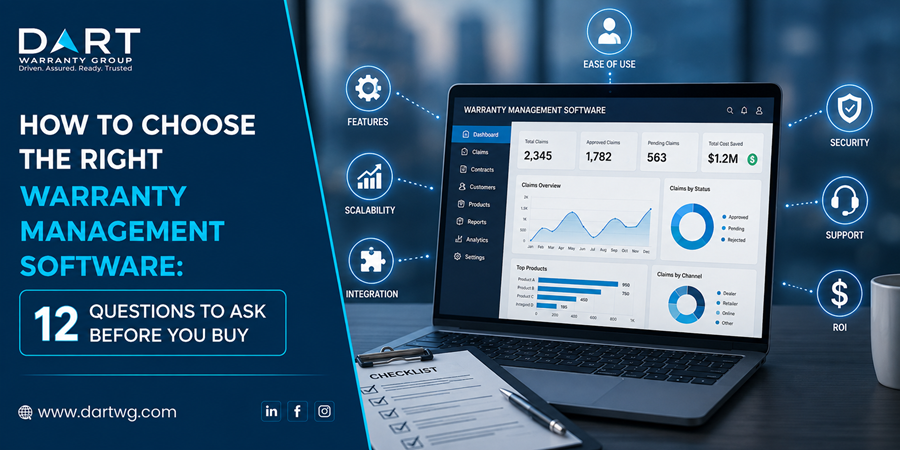
12 Questions to Ask Before You Buy
Here are 12 questions worth asking before signing a contract:
1. Does the Software Fit Your Warranty Business?
Each warranty organization has its own set of guidelines, products, procedures, and processes. While one warranty management solution platform is appropriate for one administrator, another might not be. Your appropriate warranty management solution would be flexible enough to fit into your model rather than requiring your team to overhaul its existing processes.
Asking the vendor to give you live demonstrations of real-life examples from your company will give you a better idea of what the warranty management solution platform will really be like. Show them how you process a contract registration, a claim, a repair, and an exception currently.
2. Can It Manage the Complete Claims Process?
There are very few claims that would go through the same predictable path. Some claims will have automatic approvals, while some need additional documentation, dealer explanation, or even manual processing. The ideal auto warranty claim management software must help you process your claims from the submission stage, eligibility check stage, approval stage, payment stage, and finally the closure stage.
Some of the key capabilities that the software must have include: automation of the process, configurable approval workflow, document management capability, notification, escalation workflow, and full claim history. The idea is to avoid unnecessary manual processing where it is not necessary.
3. Will It Integrate With Your Existing Technology?
Warranty management solutions typically have to integrate with CRM, ERP, accounting, dealers’ portals, payment gateways, or customer-facing applications. If the systems are operating independently, the teams will have to enter the same data more than once. Modern contract management software needs to interact with the surrounding technology landscape using APIs, integrations, or other forms of data exchange.
When talking to vendors, find out which integrations they can provide right away and which they will have to develop from scratch. Also ask who is going to maintain them.
4. Does It Support Dealer Operations?
The dealers are normally at the heart of warranty processing activities where they process claims, give information on repairs, upload documents, and communicate with the administrators to follow up on their claims approval. The best dealer claim management software should therefore offer the dealers an easy means to perform all these activities and at the same time offer the administrator better visibility of the processing within the network.
You may need to think about the system’s features that include access for dealers, permissions, claim status updates, the ability to upload documents, and notifications.
5. How Much Automation Is Really Available?
“Powered by AI” and “automated” are buzzwords in software marketing; therefore, it is necessary to move past the jargon. Make sure the vendor demonstrates precisely what level of automation is possible with the platform. In terms of evaluating auto warranty management software in USA, some helpful functions might be eligibility verification, duplicate check, routing, notifications, document handling, and rules for claims decisions.
The most effective automation is not the one that involves fewer humans, but rather the one that gets rid of repetitive work, while still making room for human intervention if needed.
6. Can the Platform Handle Future Growth?
The load that you currently have is not all that counts. The number of contracts may grow, there may be new dealers in your dealership network, and you will be developing more warranty products within your company. Your warranty management system needs to function well even as such demands go up.
Inquire about user capacity, transaction volume capacity, cloud capacity, database capacity, geographic capacity, and multi-bus capacity. When a solution does not scale, it becomes another technology headache.
7. Can It Handle Different Extended Warranty Products?
Various extended warranty programs may differ from one another by their duration, deductibles, exclusions, reimbursement process, and qualification criteria. Companies require not just a simple contract management system for dealing with all those differences. In the process of analyzing extended warranty software in Chicago, pay attention to the ability of administrators to design various products without isolating processes.
This system must allow introducing or changing warranty programs without having to redesign the whole system.
8. Does It Provide Useful Reporting and Analytics?
The warranty information does not just provide numbers for how many claims have been raised but also highlights failure trends, top-performing dealers, cost of claims, problems with products, and other operational trends. Good warranty management software would make all this information available through reports useful to business teams.
A good software package will have customizable dashboards, filters, scheduled reports, financial reports, dealer-level reports, and trend reports on claims. The ideal scenario is for managers to get this information directly without having to request IT staff to prepare a new report each time.
AI-Enabled Automotive Warranty Software Built for Modern Businesses
Discover More →9. How Secure Is the Data?
The warranty system may hold customer details, vehicle data, financial data, service agreements, maintenance details, and claims history. Therefore, security needs to be considered together with its functionality. When looking at auto warranty management software in USA, one needs to ask questions regarding encryption, authentication, authorization, auditing, backup, and disaster recovery capabilities.
One should not be given the generic answer that the system is “secure.” One needs to ask the supplier how access is granted, monitoring is done, and what the case is in an emergency.
10. Can Your Team Configure Business Rules?
The warranty policies will definitely change over time. New products will be released, reimbursement caps will be modified, and other approval procedures will develop. If all these little changes are done through the developers, you can end up with your teams being highly dependent on the software provider.
A good warranty management system should allow its administration to configure all necessary rules, forms, processes, and notifications. Make sure to see the process of configuring the system demonstrated by the vendor.
11. What Does Implementation Actually Involve?
The software implementation process encompasses far more than turning on the system. There may be a need for data migration and integration, configuration of processes, and training of employees. In evaluating auto warranty claim management software, inquire from the vendor about an actual implementation plan, which clearly outlines their responsibilities and timeframes for testing, migration, and post-launch support.
Another question to be asked is how the dealers will be onboarded if your company deals with many dealers. Successful implementation from the technical perspective does not automatically mean success from the user’s perspective.
12. What Is the Total Cost of Ownership?
Subscription pricing is just one piece of the investment puzzle. Other considerations might include the costs associated with implementation, data migration, integration, customization, training, support, more users, and ongoing upgrades. Firms weighing their options when it comes to extended warranty software in Chicago should ask for the full details on pricing.
Some elements that could be included in the comparison process are:
| Cost Area | What to Check |
| Licensing | How is pricing calculated? |
| Implementation | What is included in setup? |
| Data Migration | Are legacy records included? |
| Integrations | Are APIs and connectors extra? |
| Training | How much training is provided? |
| Support | What support levels are available? |
| Expansion | How does pricing change as usage grows? |
Build a Vendor Scorecard Before You Decide
After formulating the responses to these questions, use them to develop a straightforward vendor scorecard, paying attention to assigning higher scores to the factors that have more significant influence on your company, and not to giving equal scores to all of them.
For instance, claims management may be very important for a volume-based administrator, whereas flexible integration for businesses with a complicated technological background. Businesses in search of warranty management software should consider the platforms based on their needs, and not choose the one with the largest list of features.
Such a scorecard could contain the following factors:
- Claims processing
- Contract administration
- Dealer collaboration
- Automation
- Integrations
- Reporting
- Security
- Scalability
- Configuration
- Implementation
- Support
- Total cost
The Bottom Line
Prior to choosing auto warranty management software in USA, engage those who would be using this software daily in the decision-making process. The claims team, administration, financial department, IT, customer service, and dealers’ management may have different goals. Involving these departments in the purchase process might help recognize potential problems and make your decision grounded in practice.
The same approach should be used when choosing extended warranty software in Chicago. Spend enough time trying various scenarios, doubting vendors’ statements, figuring out installation needs, and calculating total ownership costs. This careful evaluation of the system might save you from purchasing new software in the future.
Frequently Asked Questions
1. What should I look for when choosing warranty software?
Watch out for the following: Automation, Contract Management, Configurable Workflows, Dealer Collaboration, Integrations, Reporting, Security, Scalability, and Usability. However, most importantly, ensure that the platform supports your business processes.
2. Can warranty software automate claims processing?
Yes. Based on the system in use, automation can carry out functions like verification of eligibility, routing of claims, duplicate identification, document management, notifications, and some rule-based decisions, while leaving complex cases to be reviewed by humans.
3. Is cloud-based warranty software better than an on-premises system?
The cloud provides better scalability, remote access, automatic updates, and less infrastructure management. But the best one would depend upon your security needs, integration environment, operations mode, and information technology strategy.
4. How long does warranty software implementation take?
The time needed to implement will be dependent on system complexity, data migration, integrations, customization, number of users, and dealer setup needs. The supplier should give you an implementation plan after analyzing your environment.
5. How can businesses calculate the ROI of warranty software?
ROI may be calculated by comparing the following to the total cost incurred for software purchase: decreased claims processing time, decreased administrative expenses, fewer errors, increased payment speed, increased efficiency of the dealers, decreased leakage, and increased visibility of warranty performance.
Leave a Reply
Recent Posts






Daniel Kozlowski
Designation: Co-Founder
With over 30 years of experience in the extended warranty and service contract industry, I help businesses modernize warranty operations and optimize claims management processes. As the founder of DRK Resources Tech LLC, I share insights focused on warranty management, service contract solutions, and automotive technology trends.