
Daniel Kozlowski
20 Nov 2026
No Comments
What occurs once the customer leaves the vehicle lot with a vehicle service contract?
Many believe that the narrative is over. In fact, the real story is just starting.
Here is why. A few months go by, and the check engine light starts blinking. The customer wonders whether the service is covered and needs an immediate response. If you manage to find the necessary information quickly and approve the claim effortlessly, then the client is going to trust you and return. Otherwise, he/she will post a negative review instead.
Why is this step so difficult for many dealers? They use spreadsheets, emails, and hard copies, which make quick responses impossible.
Fortunately, the solution is quite simple. Using a modern warranty management system and introducing a few process changes, you can transform a cumbersome back office procedure into an opportunity to attract more loyal clients. Let us see how.
Why the Journey After the Sale Matters
The Vehicle Service Contract is a commitment. The client invests upfront for assurance of security, and the worth of the commitment becomes evident much later on, when they are under pressure, in distress, or caught off-guard with a repair bill. This is why administration is more than just documentation. It is the end product, and with the help of warranty management software, your commitment can be fulfilled every step of the way.
The Customer’s View
On the part of the driver, the ideal experience is quite straightforward. The driver knows what is covered; the driver knows whom to contact; the claims process is smooth sailing. A negative experience can be just as easily defined. It would include the loss of papers, numerous phone calls, and confusion over coverage issues.
The day a contract was purchased tends to slip one’s memory. However, the day it was used is remembered quite well. If things went well, then trust is built. If things went poorly, then the repercussions are felt at the point of purchase.
The Business View
Practical considerations apply to dealers, finance & insurance (F&I), and third-party administrators. Delays result in cancellations, chargebacks, and angry repair partners. Lack of proper record-keeping means regulatory compliance issues. Time gets wasted on status phone calls when all of those should be automated.
It has been discovered that having an agreement management system in USA comes in handy when all documents, amendments, and customer information are stored in one place where everything can be accessed easily rather than having to search through email chains just to find out something very basic.
Where Administration Typically Breaks Down?
Before enhancing the experience, we should understand where things may go wrong. Issues can be categorized into three major categories.
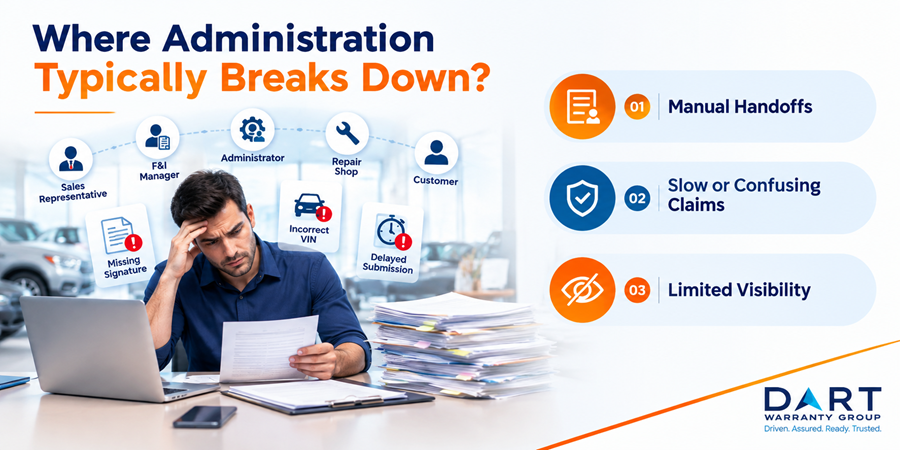
Manual Handoffs
A vehicle contract may come into contact with a number of people: the sales representative, the F&I manager, the administrator, the repair shop, and the consumer. In each of these touchpoints, there is an opportunity for the signature to be missing, the VIN to be incorrectly entered, and the submission to be delayed.
Quality contract management software in the USA can ensure that the necessary fields are entered accurately and routing of approvals happens automatically.
Slow or Confusing Claims
This is where the rubber hits the road. With approvals taking days and the repair shop waiting, the customer is affected immediately. Uncertainty over coverage is exacerbated when employees need to determine what the coverage means for themselves each time. The interpretations can be different between each agent, which breeds distrust.
A reliable warranty management system follows the same rules for coverage every time, thus giving the same result regardless of which agent is at the receiving end.
Limited Visibility
Questions that leaders can never be able to answer include: How many agreements are about to expire this quarter? What are the products causing the most claims? Where are the renewals falling through? Without information, decision-making is based on intuition rather than facts.
A warranty management system that is designed well transforms these questions into reports rather than spending days in the spreadsheets.
The underlying factor for all three issues is the same, there is no place where all this information can be found. This is where auto contract lifecycle management comes in handy. It monitors all the agreements from creation to either renewal or expiration, generating alerts and records that are kept up to date.
Building a Smoother Journey, Step by Step
One does not have to change everything at once. Consider improvements to be a series of gradual changes that work together.
AI-Enabled Automotive Warranty Software Built for Modern Businesses
Discover More →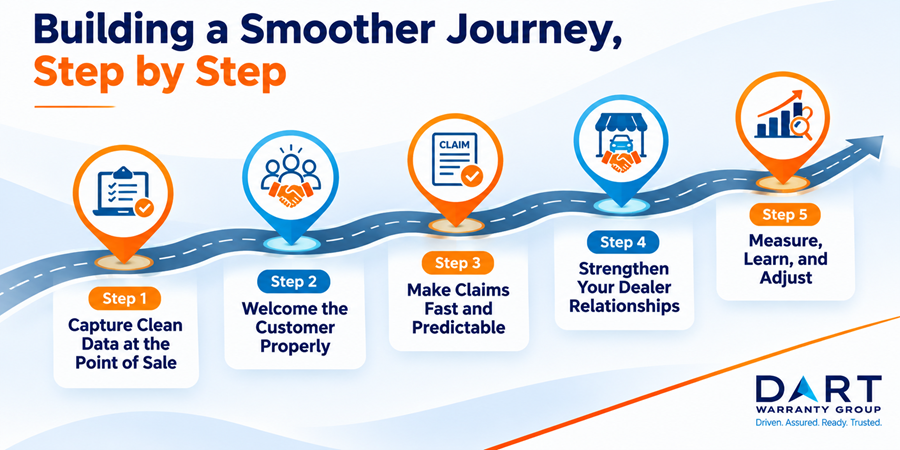
Step 1: Capture Clean Data at the Point of Sale
Correctness begins at the desk. Make sure you use electronic forms that have all the necessary fields, VIN verification, and e-signatures to catch errors at the source. A few seconds of double-checking at the time of signing can save lots of time later on.
There are many teams that use auto contract lifecycle management software for just this purpose.
Step 2: Welcome the Customer Properly
Most customers will have forgotten the fine print of their agreement within a matter of weeks. This is where a good welcome message can help. The customer should get a concise email or text message that includes a summary of their cover, a phone number for making a claim, and a document link.
Step 3: Make Claims Fast and Predictable
Establish procedures for the process of claims submission, review, and approval, and automate standard ones. The straightforward ones could be approved automatically by the system according to certain criteria, while the rest go through manual review. Provide repair shops with an easy method of checking claim status online so that they would not bother you with phone calls anymore.
Step 4: Strengthen Your Dealer Relationships
Your dealers are the first point of entry to your contracting business. This means that the conditions between you and them need to be clear and accessible. The conditions regarding commission, the responsibility for reporting, and eligibility for the products can all be kept in a dealer agreement system in USA. This allows you to make sure that everyone is working off the same page.
Step 5: Measure, Learn, and Adjust
Lastly, keep track of some key figures: time taken to approve a claim, customer satisfaction post-claim, renewals, and reasons for cancellations. Analyze them monthly. With such an insight into the source of friction, the solution becomes straightforward rather than something one needs to guess about. Improvement is generally more effective when done in small bits rather than with one big project which remains incomplete forever.
The agreement management system in the USA can integrate all such numbers on one dashboard.
A Quick Note on Change Management
Technology is not everything. Employees must know why this process is important and how it will make their lives easier. Pick out a few pain points and use actual examples to teach employees. Celebrating successes will help them see the benefits.
Dealers have to be onboarded as well. Prove to them how easy it is to use a dealer agreement system in the USA, and you will win their support.
Final Words
The sale generates the income, but the administration of the process makes your reputation. The customer measures the contract for service in terms of how it works for him/her, and all lost papers, delayed approvals, and uncertain responses only hurt his/her trust. By cleaning up data in advance, communicating properly, processing claims faster, improving relations with dealers, and analyzing results, you can build such a post-sale experience that is worth talking about.
With the right tools in place, everything becomes a lot simpler. The right choice of contract management software in USA will provide you with an organizational framework in which your team will be able to function effectively and efficiently as the volumes increase. Products offered by DART Warranty demonstrate how modern technology can help in this task, enabling your team to work more with people rather than documents. Begin with something small, solve one issue with friction this quarter, and continue.
Also Read: Top Competitors in F&I Administration, Vehicle Service Contracts, Warranties, and Claims Management
FAQs
1. What is vehicle service contract administration?
This is a series of actions performed throughout the duration of a contract, starting from its sale till the time it expires. They include customer and automobile data registration, documentation issuance, claim handling, payment processing, cancellations or renewals, and accurate record-keeping.
2. Why is the post-sale customer experience so critical?
It is the post-sale experience that lets customers try out the product or service they have purchased. Positive experience results in loyal clients, while negative – in cancellations and bad reviews. Since customers often correlate experience with the selling dealership, the post-sale experience plays a crucial role in its reputation and finances.
3. How can I speed up vehicle service contract claims?
Firstly, you need to formalize your claims process and automate routine decisions according to set criteria. Let repair shops be able to make claims via the Internet and ensure that all the coverage requirements are clearly formulated. Most companies use warranty management software to manage claims data.
4. What are the common administrative errors?
The most common problems are wrong information regarding the vehicle or customer, absence of signature, late submission of contracts, lack of clarity in explaining the cover, and inability to track the date of renewal. All of these mistakes occur due to the manual handoff, and that’s why the use of digital forms and validations plays an important role.
5. What signals should I look out for when evaluating whether the process is outdated?
If you find that you get a lot of calls from customers about the status of their contract, approvals of claims that take a long time, documents stored at different locations, and difficulty in generating simple reports, then it is time to update your process.
Leave a Reply
Recent Posts





Daniel Kozlowski
With over 30 years of experience in the extended warranty and service contract industry, I help businesses modernize warranty operations and optimize claims management processes. As the founder of DRK Resources Tech LLC, I share insights focused on warranty management, service contract solutions, and automotive technology trends.