
Daniel Kozlowski
13 Nov 2026
No Comments
All TPAs dream of more dealerships, more agreements, and more claims. But with all the advantages of that growth comes one hard truth: the systems that served you well before are not meant for your future needs. The spreadsheet system begins to look dated, and e-mail approval processes are slowing down everything.
That is why scalability should no longer be considered just as an operational problem but rather as a business decision. In today’s market environment, the TPAs that make the required investment at the early stages to set up the right operating model, along with warranty management software providers in the USA, will be the only TPAs that will be able to scale effectively.
However, how are you supposed to understand whether your company is prepared enough for the task? You first have to take into account these five aspects. Let’s take a look:
1. Claims Processing and Workflow Automation
Why Claims Are Essential to Your Scalability
This is where you come under the test with your promise to the customer. Every single delay, revision, or manual approval adds cost. If your claim reviewers are still manually transferring information from one system to another, then costs are going to increase with volume.
What Leaders Should Ask
- What is the number of claims that are auto-adjudicated?
- What is the time taken by an average claim to be processed and paid?
- Are the exceptions automatically forwarded to the relevant reviewer?
The objective of a modern warranty management system is to auto-manage the entire process, including intake, eligibility checking, authorization, and payment, through one single workflow. The objective is very simple, leave the hard decisions for humans, and let the system handle everything else.
2. Dealer and Partner Integration
The strength of your network depends on its connections
Dealers are your first line of defense. It is via dealers that you will manage to sell your contracts, handle your claims, and answer any first-time queries from your customers. The speed at which you can get your new dealers up and running will determine how fast you grow your sales.
What Leaders Should Ask
- Is it possible for you to onboard new dealers through a simplified process?
- Do you have any real-time integrations with dealer management system in USA, or is your system dependent on manual uploads?
- Do you have any self-service portals that enable the dealers to register their contracts and check the status of their claims?
The use of Open APIs and predefined connectors ensures minimal errors and duplication and makes your TPA a delight for the dealers to work with.
3. Product Flexibility and Contract Management
Can You Start New Projects Without Overhauling Everything?
The market is very dynamic. If you need any new vehicle types, new coverage levels, or even some customer-specific term structures, it’s just about adjusting your software configuration, not developing one. The inflexibility of a system makes TPAs reject deals.
What Leaders Should Ask
- Can product rules, rates, and terms be changed without programming?
- How fast can you become operational using a new policy with a new client?
- Does your extended warranty software support different kinds of products like vehicle warranty, powertrain, and appliance warranties in a single application?
Being configurable allows you to test different policies in a short time, attract clients with personalized products, and save money in expansion.
4. Data, Analytics, and Fraud Control
What You Cannot Measure, You Cannot Scale
Nonetheless, as the volume grows, small leakages become significant losses. Without knowledge of the loss ratio, claim severity, time taken to fix, and recurrence of the problem, one would be forced to address the consequence of the problem when it happens.
What Leaders Should Ask
- Is your dashboard a real-time display, or do you need to rely on monthly reports?
- Do you have the ability to detect patterns of claims fraud, duplication, and overstating estimates using automation?
- Does your software have the flexibility to allow reports based on clients, dealers, products, and geographic regions?
TPA warranty software will help transform data into actions, detecting any outliers and helping you negotiate better rates and advise underperformers.
5. Compliance, Security, and Platform Scalability
Trust is an Expanding Resource
TPAs handle confidential information belonging to their clients, and they need to adhere to state laws as well as client auditing requirements. The more the number of states and clients involved, the more challenging the process becomes. An unscalable platform creates more hurdles than solutions.
What Leaders Should Ask
- Are audit trails, role-based access control, and data encryption features available?
- Is the system able to handle multiple clients, entities, and currencies?
- Can the architecture support cloud computing, and can it be tested under peak loads?
Selecting the right third-party administrator software will give you the opportunity to venture into other markets without any worries.
Also Read: Why TPAs Are Replacing Legacy Warranty Platforms With AI-Powered Solutions?
Beyond the Five Areas: Customer Experience and Service Quality
The Customer Will Never See The Back Office
The customer does not care about how perfect your process organization is; the customer cares only about speed, communication, and fairness. With more volume, the quality of service will inevitably deteriorate and will be the first thing noticed by your customers.
The answer to the problem of customer inquiries lies in processing a high volume with consistency. Standardized status reports, standard time for processing, and automated reminders by SMS and email are the main ways to avoid these unnecessary “Where is my claim?” phone calls.
Turning Service Into a Selling Point
TPAs that can offer claims that are fast and transparent in nature will get more renewals and referrals from their customers and dealerships. The new extended warranty software will assist in achieving this goal by giving the customers the capability to use the self-service portal for looking into their coverage, filing claims, uploading documents, and monitoring the repair process without making a phone call.
AI-Enabled Automotive Warranty Software Built for Modern Businesses
Discover More →Service metrics that are to be measured every week include first contact resolution rate, time to approval, repeat contact rate, and customer satisfaction rates. If these numbers stay constant despite an increasing number of claims, you have been scaling, not stretching.
Common Mistakes TPAs Make When Scaling
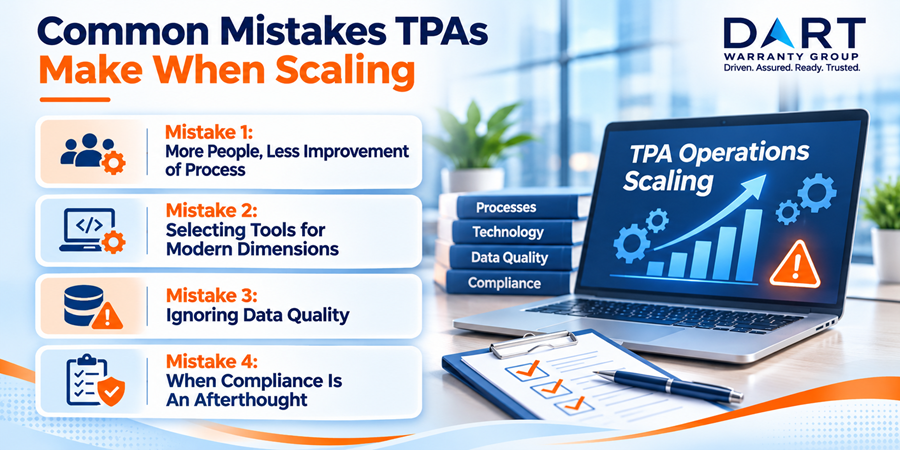
Mistake 1: More People, Less Improvement of Process
With growing backlogs, the first move would be to hire additional personnel. Hiring extra personnel will definitely help solve the problem at hand, but in an operation that remains manual in nature, costs will increase alongside the increasing workload. Automate routine activities and then hire personnel for making decisions.
Mistake 2: Selecting Tools for Modern Dimensions
What works for you today might not be enough tomorrow because of the growth. It is important for the leaders to see if what they are doing will work in the future. There needs to be more dealers, customers, states, and product lines that need to be accounted for. With warranty management software USA that can accommodate multi-client configuration and integration, there is going to be no migration hassle in the near future.
Mistake 3: Ignoring Data Quality
Reporting becomes inconsistent because of incomplete contract documentation, duplicate customer data, and manual records when claims are processed. The use of mandatory fields, drop-down boxes, and other types of data validation while entering data will guarantee you get consistent results from your reports.
Mistake 4: When Compliance Is An Afterthought
Auditing requirements and customer audits are only becoming more difficult. It is cheaper to incorporate the auditing trail, the authorization process, and record-keeping into workflow procedures than to apply them as an afterthought.
A Practical Readiness Checklist for TPA Leaders
Questions to Ask Your Team This Quarter
Use this simple checklist when reviewing your next leadership. If you answer no or not sure to multiple questions, scalability should be a concern to address now.
- Are our assertions moving from intake through decisions with minimal manual intervention?
- Can we bring a new dealer on board easily?
- Are we getting our data in real time from the dealer system or uploading it?
- Can we get a new coverage plan up without customization?
- Do we have a live dashboard for loss ratio, claim cost, and turnaround time?
- Is our fraud flagging done automatically?
- Can customers check the status of their claims without reaching us?
- Are there full audit trails and role-based access in place?
- Can our system handle many more claims than currently?
- Do we review operations with our clients each month?
Turning Answers Into Action
When you have the answers, prioritize them based on their importance and how difficult they are to implement. The easiest to do are fast wins, which include things like notifications and standardization of information. Major changes, such as transitioning to specialized TPA warranty software, should be done through phases in order for them to gain traction rather than cause disruptions to service delivery.
Final Words
Scalability does not mean doing more while putting in the same amount of work. Rather, scalability is about creating an operation where expansion results in increased revenues rather than added chaos. Look at your claims workflow process, dealership integrations, product versatility, analytics, and compliance readiness in an honest light, and you will soon see how the holes have emerged.
For those executives who are willing to fill in those holes, integrating an auto warranty management software solution may very well be the quickest way to get there.
Also Read: Top 7 Challenges TPAs Face in Warranty Claims Management
FAQs
1. How do you define scaling up a TPA business?
Scaling up a TPA business involves expanding the number of contracts and claims, the number of dealer partners, and client programs without a corresponding increase in costs, mistakes, or turnaround time through automation and technological advancement.
2. What is difficult for growing TPAs?
TPAs struggle with manual claims processing, long onboarding times for dealers, poor visibility of loss ratios, and increased state compliance requirements, among other issues.
3. How can a TPA automate their claims process?
TPA automation involves validation of insurance coverage, application of business rules, exception handling, and payment without any data entry.
4. What are the performance indicators that TPA leaders need to consider to gauge the health of their operations?
The important metrics are turnaround time on claims, auto adjudication percentage, loss ratio, average claim cost, dealer responsiveness, first contact resolution, and customer satisfaction ratings.
5. At what point is the right time to upgrade TPA technology platforms?
It is when you have reached a stage where you have started to feel the pressure. The early warning signs are a growing backlog, heavy dependence on Excel, delayed reporting, inability to introduce new products, and dealer complaints.
Leave a Reply
Recent Posts





Daniel Kozlowski
With over 30 years of experience in the extended warranty and service contract industry, I help businesses modernize warranty operations and optimize claims management processes. As the founder of DRK Resources Tech LLC, I share insights focused on warranty management, service contract solutions, and automotive technology trends.