Daniel Kozlowski
06 Nov 2026
No Comments
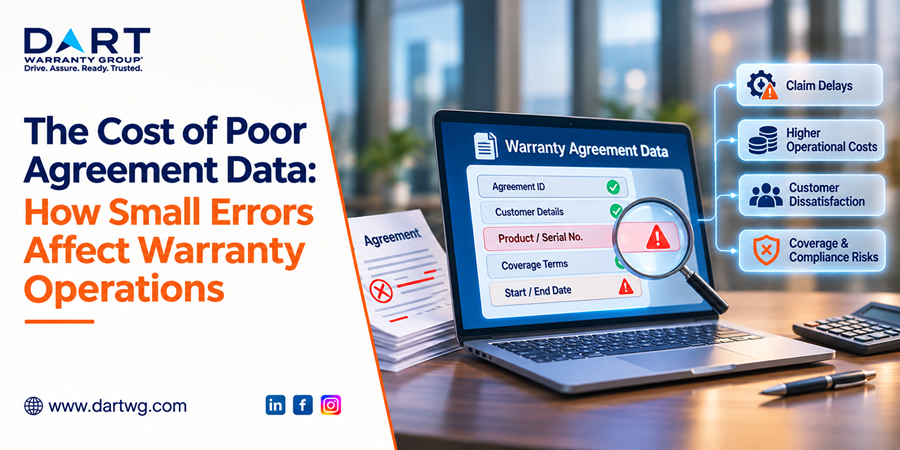
A miswritten VIN number, an incorrect coverage period, or an expired dealer agreement may not be a problem when viewed individually. In the warranty management process, however, such minor mistakes become magnified as claim denials, late payments, audit nightmares, and customer dissatisfaction. The best-developed warranty management system is no more than good as the data that flows into it.
This guide will examine the sources of bad agreement data, its cost, and solutions to the problem. Let’s take a look:
Why Agreement Data Is the Foundation of Warranty Operations?
Every claim process begins with an agreement. It specifies what is being covered, the period, the conditions, and the party that bears the cost. When claims processes, dealerships, and financing base their work on the same document, things run smoothly.
If this document is incorrect, the entire system collapses. Agreement management systems have been designed to make sure these terms remain accurate and consistent at all times throughout the claim process.
Where Small Errors Creep In?
The majority of issues relating to agreement data are subtle rather than being significant and noticeable.
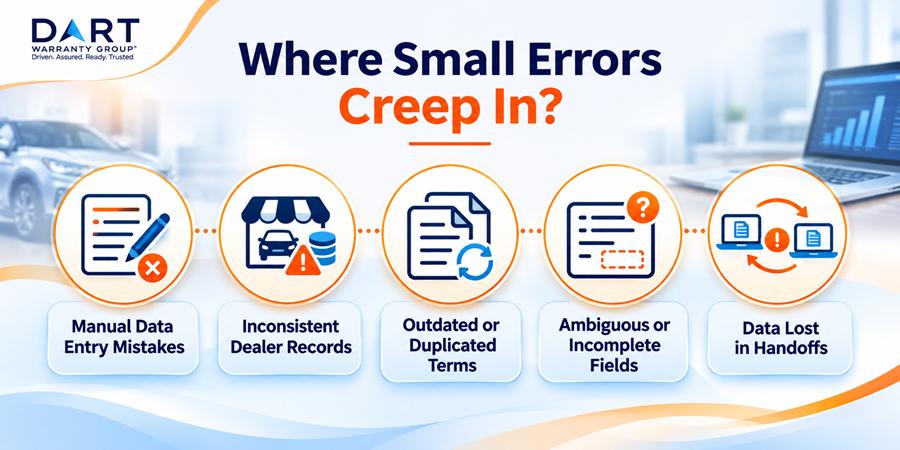
Manual Data Entry Mistakes
Common mistakes include typos on the VINs, transposing the digits in the mileage limit, and the use of an incorrect start date. One typo in the claim number will render it invalid by appearing as that of an uninsured vehicle.
Inconsistent Dealer Records
Different variations may be common among dealers when the terms have been amended via email or spreadsheet. For dealer agreement management in USA operations, the use of a dealer agreement management system will help to ensure that all dealerships operate under one agreed-upon and current version of the agreement.
Outdated or Duplicated Terms
Changes are made to coverage conditions, contracts are renewed, and exemptions are created. If there is no system of version control, then employees will have to apply old coverage conditions for new claims, or there may even be two different versions of the same contract.
Ambiguous or Incomplete Fields
Open-ended text boxes, undefined deductions, and ambiguously stated exclusions create leeway for individual interpretation. When two different individuals interpret a particular clause in two different ways, one claim can be accepted, while another, which should be accepted according to that clause, will be rejected.
Data Lost in Handoffs
The information contained in the agreement often goes from sales through finance through claims to the dealers. At each step, there is an opportunity for the information to be retyped, shortened, or lost. The more systems and spreadsheets used, the higher the chances of the final information being different from the original one.
How Small Errors Snowball into Big Costs?
Claim Rejections and Rework
Where there is a mismatch between the data and the claim, the claim is rejected or referred for reconsideration. Each of these cycles takes up staff time and involves following up with the dealer; multiply that by the number of claims, and you can see how much labor costs are involved.
Delayed Reimbursements
Dealers hold payments until disputes have been sorted out. Late payments create pressure on dealers that may influence their decision to attend to warranty work.
Compliance and Audit Risk
Warranties have internal controls and external checks. Discrepancies and inaccuracies in agreements increase the difficulty and risk involved in conducting an audit, and may expose the company to problems regarding what was guaranteed.
Customer Frustration and Lost Trust
Consumers don’t care about data quality; they care about coverage. Errors in coverage result in rejected claims, confusing statements, and loss of customers’ loyalty. Good extended warranty software can help with that by making sure all the terms of the plan, eligibility, and expiry date are correct right from the beginning.
A Simple Example of the Ripple Effect
Consider the instance of the wrong coverage expiration date entered in the system by a month. The car gets brought into the shop, denied, absorbed in cost for repairs or a dispute on the claim, calls are made to the support center, and an investigation by a claims analyst happens. That is all because of a single keystroke.
Also Read: From Agreement to Payment: How Connected Warranty Operations Reduce Costs, Delays & Claim Leakage
The Hidden Costs Most Teams Never Measure
The obvious costs of poor data can easily be seen, for example, a claim denied or a delayed payment. The less obvious ones are usually more significant.
Time Spent on Investigation
Analysts who devote themselves all day long to identifying disparities are not looking at trends, preventing fraud, or improving processes. The lost ability does not get reflected in budgets but certainly slows down everything.
Inflated Operating Costs
Additional phone calls, emails, and manual corrections accumulate over time. In one year, even small errors can amount to considerable man-hours of correcting mistakes that were unnecessary from the start.
AI-Enabled Automotive Warranty Software Built for Modern Businesses
Discover More →Unreliable Reporting
If the underlying agreement documentation is not consistent, reports on claims rate, liability, and profitability will be invalid. This means that management will make decisions regarding pricing and programs using figures they cannot totally trust.
Overpayments and Leakage
Denials are not the sole result of errors. Entering the insurance term of coverage in a liberal manner could result in overpayments. Overpayments seldom get detected, and they chip away at margins.
Which Teams Feel the Impact Most?
The problem of poor agreement data is not just about claims. This issue affects practically all departments in the warranty lifecycle.
- The Claims department deals with more rejections and longer processing times.
- Dealers have problems with delayed payments and confusion with coverage information at the service desk.
- Finance has difficulties with incorrect accounting and missing reconciliations.
- The Customer Service department deals with frustrated customers because of rejected or complicated claims.
- The Compliance department needs to spend more time checking information that must be accurate in the first place.
When the problem in one department turns into extra work for another department, the actual cost is diluted and hard to see.
How to Fix Poor Agreement Data?
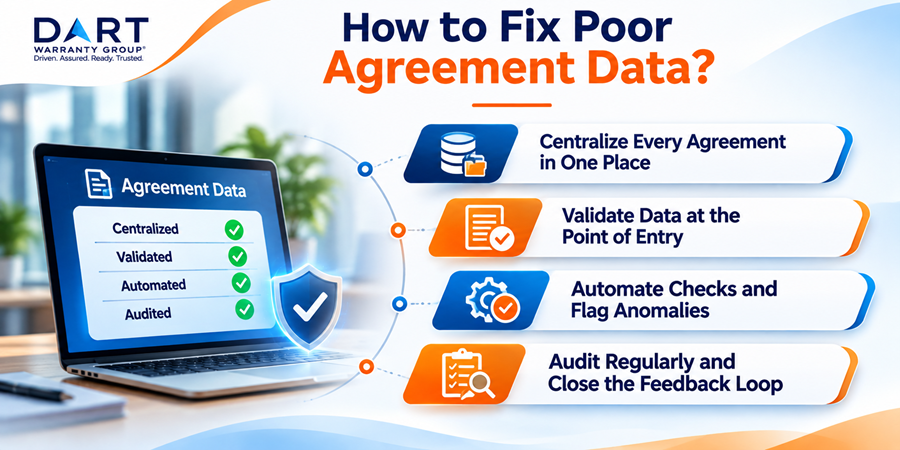
Centralize Every Agreement in One Place
Inconsistency is guaranteed by having PDFs, spreadsheets, and email attachments spread all over the place. With contract management software, you can consolidate your information into one source of truth.
Validate Data at the Point of Entry
The cost of catching mistakes at an early stage will be significantly less compared to that of making corrections later when the claims have already been filed. Through the use of built-in validation, required fields, and VIN checking, bad information cannot get into the system. This is found in the best auto warranty management software in USA.
Automate Checks and Flag Anomalies
Though humans excel in making judgments, they fail to notice several small incongruities. The use of AI in the warranty process will allow matching the claim with the terms of the agreement, detecting any discrepancy, noting unusual patterns, and sending those cases for scrutiny.
Audit Regularly and Close the Feedback Loop
Identify the top reasons for claim rejection and go to their root cause. Pass on this information to the dealerships and internal personnel so that these errors do not keep repeating themselves.
A Practical Checklist for Better Agreement Data
If you do not know where to begin, follow this process:
- Audit a sample of agreements to gauge your current error rate.
- Identify the top three error types causing rejections.
- Develop standardized templates and field definitions for collecting the right information from all agreements.
- Establish accountability for the accuracy of the data throughout the life cycle of an agreement.
- Educate the dealers and employees on how to avoid the most common mistakes.
- Monitor metrics such as claim rejection rate, time spent on rework, and time until reimbursement.
- Repeat quarterly as program and product offerings change.
This is another area where small changes add up just as quickly as small mistakes.
Final Words
A lack of proper agreement data does not come with any kind of warning label. It presents itself through delays in claim processing, tense relationships between dealers and customers, increased administrative costs, and disgruntled customers. The silver lining here is that all these challenges are avoidable. Centralizing the agreements, verifying data on input, and using automation will make sure of that.
Also Read: From Connected Data to Intelligent Warranty Operations: The Role of AI, APIs & Reporting
FAQs
1. What is the meaning of agreement data in warranty processing?
Agreement data is all of the information that describes the terms of a particular warranty or contract service. This includes coverage, start and end dates, mileage limitations, deductibles, exclusions, and parties involved. The claims are evaluated based on the agreement data to determine whether there should be a payout.
2. How does data discrepancy cause the rejection of warranty claims?
Claims are evaluated automatically or manually against the terms of the agreement stored in the system. Even one incorrect date, VIN number, or term will create a difference and result in the invalidity of the claim, which will be either rejected or returned.
3. What are the consequences of wrong warranty agreement data?
The cost is visible in rework, delays, disputes, overpayments, audit costs, and loss of customer loyalty. Small individually, they add up rapidly.
4. How can organizations improve the quality of their warranty agreements data?
Organizations can centralize warranty agreements in one system, validate warranties through rules when entering data into systems, keep versions up-to-date, audit regularly, and apply automation to ensure inconsistencies do not arise before claims are handled.
5. Can automation/AI prevent mistakes in claims handling for warranty agreements?
Yes, organizations can automate the checking of agreements and identify inconsistencies, while AI can help learn from previously rejected claims.
Leave a Reply
Recent Posts






Daniel Kozlowski
With over 30 years of experience in the extended warranty and service contract industry, I help businesses modernize warranty operations and optimize claims management processes. As the founder of DRK Resources Tech LLC, I share insights focused on warranty management, service contract solutions, and automotive technology trends.