Daniel Kozlowski
08 Jun 2026
No Comments
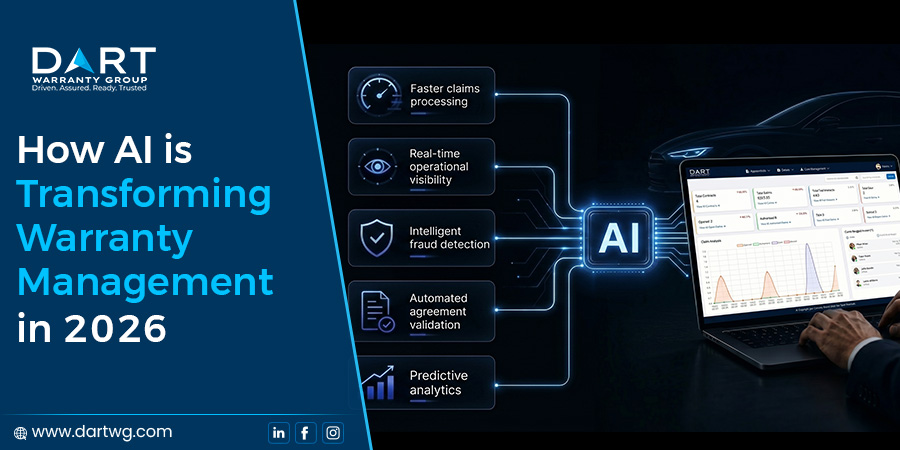
2026 has been a game-changer for top-level to mid-level industries; businesses will no longer struggle with slow, manual warranty processes. Instead of choosing an old, slow, and manual system, businesses opt for leveraging AI (artificial intelligence) to create rapid, more dependable, and smarter systems than before. Also, customer satisfaction and operational effectiveness are now tactically driven by what was earlier a back-office activity.
But how does this change affect both businesses and consumers? How are companies reconceptualizing auto warranty management software in today’s AI-powered world?
This rapid transformation indicates that auto warranty management helps businesses process warranty claims faster, reduce investments, and improve decision-making through real-time data. On the other hand, faster resolution, greater transparency, and a more suitable experience can benefit consumers. Businesses, especially in the automotive sector, are transforming the way of managing claims, prevent fraud, and improve the quality of the product as a consequence of the development of AI in warranty management software.
Let’s have a look at this comprehensive guide to thoroughly understand warranty management and warranty software before diving into the role of AI in warranty management.
What is Auto Warranty Management?
Auto warranty management is a comprehensive process to make sure that the vehicles and their components are protected from defects and failures for a certain time after purchase. Moreover, this is well beyond simply acknowledging repairs or replacements, but also includes claims verification, service logistics management, and control of costs related to warranty fulfillment.
Understanding Auto Warranty Management Software
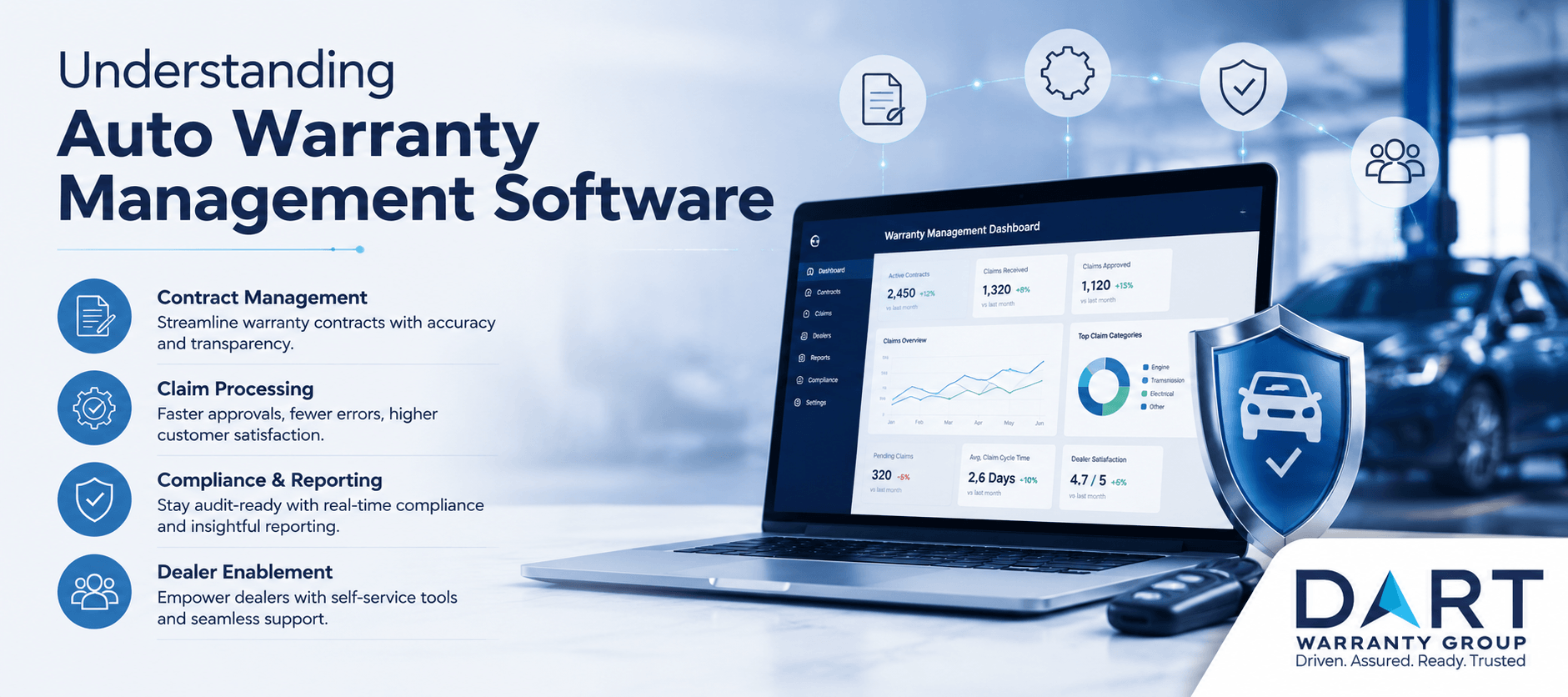
Automotive warranty software enables third-party administrators, F&I administrators, and dealers to manage their service contracts, extended warranties, and F&I programs seamlessly. The new-age software solution replaces old-age TPA solutions and spreadsheets by providing one centralized solution comprising the following four functions:
- Contract Management: VIN-level contract management, mileage-based eligibility, tiered pricing on the dealership level, and configuration of rates.
- Claim Processing: Flexible processing rules for parts, claim amount limitations, claim routing rules, and approval process customization.
- Compliance & Reporting: State regulation filings, reinsurance reportings, and warranty reserves reporting.
- Dealer Enablement: Self-service portal integration, DMS integration, and F&I-friendly menu options.
Who Benefits from Auto Warranty Management Software?
Third-Party Administrators (TPAs): TPAs manage warranty programs for dealers, finance companies, and warranty product providers. They use auto warranty management software to handle multi-client operations, apply client-specific coverage rules, and process large volumes of warranty claims across diverse dealer networks.
F&I Product Administrators: These companies design, price, and manage F&I products, including VSCs, GAP, tire-and-wheel, and maintenance agreements, using the platform to oversee the entire product lifecycle from rate configuration to claims and cancellations.
Dealer-Owned Warranty Companies (DOWCs): Dealers and dealer groups that self-insure through reinsurance or retro structures require a platform that tracks premium allocation, reserves, and claims per dealer with the financial transparency needed for DOWC programs.
Extended Warranty Providers: Companies selling aftermarket warranty products direct-to-consumer or through agent networks rely on the platform to manage policy issuance, claims processing, and customer communications efficiently at scale.
Perhaps the above guide helps understand automotive warranty management and warranty software. Now, let’s take a look at the guide below to understand AI in Warranty management.
Understanding AI in Warranty Management
AI in warranty management is the integration of modern technology into warranty claim management software, such as automated systems, machine learning techniques, and data analytics. With minimal input from humans, these technologies allow us to derive insights, identify trends, and make informed conclusions.
Core Components of AI-Driven Warranty Systems
AI-powered warranty software is founded on a number of foundational elements that collaborate to make the best utilization of the complete warranty lifecycle. Among them are the following:
| Component | Explanations |
| Claims Automation | Uses a rule-based algorithm and machine learning techniques to streamline the intake, validation, and payment of warranty claims. |
| Predictive Analytics | Predicts product failure and minimizes unplanned breakdowns by evaluating both previous and current data. |
| Fraud Detection | Uses an AI algorithm to identify suspicious trends and prevent false claims. |
| Personalized Customer Experience
|
Offers immediate support through chatbots, customized warranty suggestions, and real-time updates. |
| Integration with Connected Devices
|
Allows proactive warranty checks as well as quick problem-solving through the use of IoT and data from telemetry. |
The Growing Need for AI in Warranty Management
As industries are becoming more complex day-by-day, conventional systems fail to keep up. Therefore, the use of AI is more suitable to tackle key challenges that businesses face these days:
Increasing Complexity of Products: Auto warranty management is more important since modern vehicles and electronics produce a huge amount of data.
High Customer Expectations: Because users expect instant solutions, AI-driven claim processing is the only way to meet customers’ expectations.
Rising Operational Costs: AI significantly decreases costs when compared to manual processes.
Fraudulent Claims: AI enhances the management of auto warranty claims by detecting worrisome trends early on.
How AI Is Transforming Warranty Management?
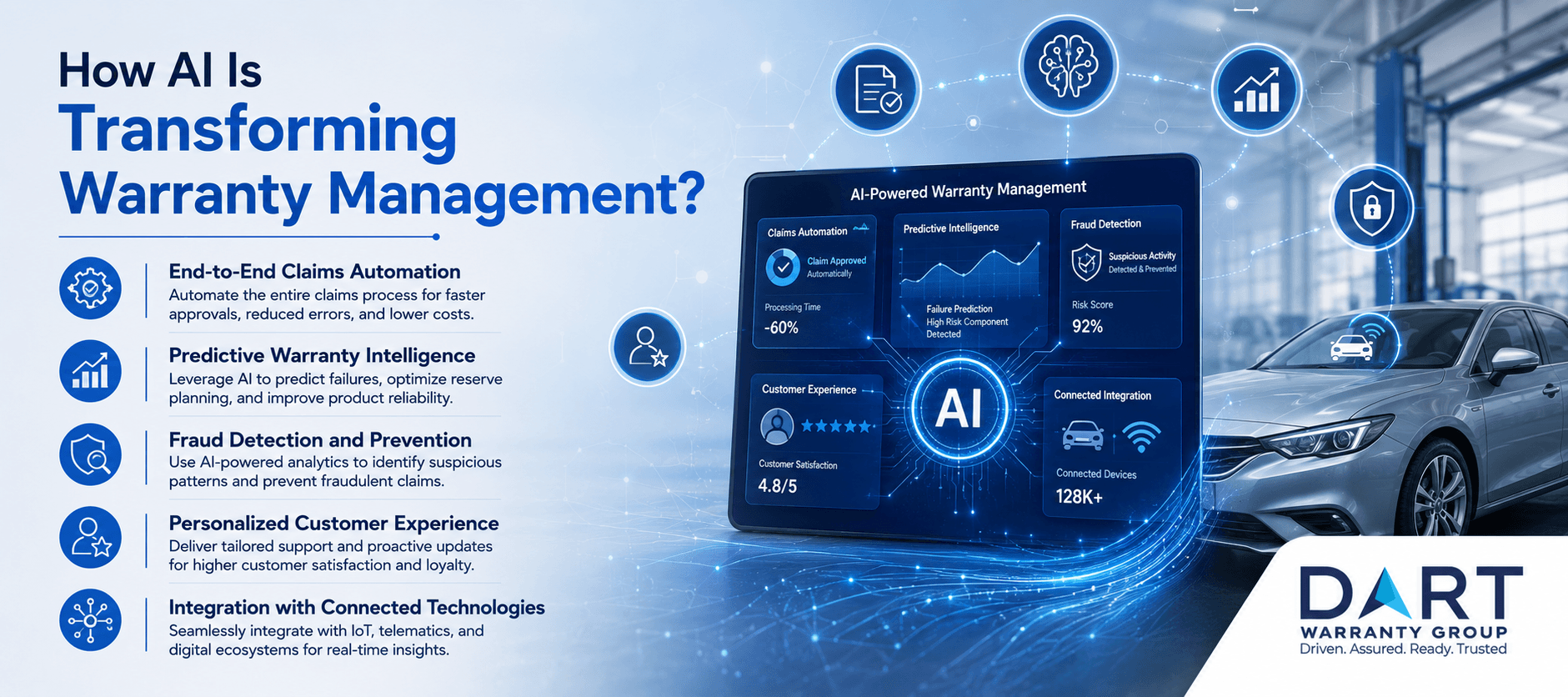
AI enables complete claims automation. Let’s take a look at the following:
End-to-End Claims Automation
From claim submission to settlement, AI is the only way to make it a complete auto claims process.
Traditional vs AI-Driven Claims Process
| Feature | Traditional Claim Process | AI-driven Claim process |
| Speed and Efficiency | Manual review and processing are often laborious and time-consuming. | Automated data extraction and decision-making, resulting in quicker claim processing. |
| Accuracy and Error Reduction | Unreliable and prone to human errors | Uses algorithms to limit errors and enhance consistency in claim assessments |
| Fraud Detection | Depends on manual checks and historical data, which may overlook sophisticated scams | Uses pattern recognition and anomaly detection to spot potential scams more effectively |
| Customer Experience | Longer wait times and less transparency for claimants | Provides the fastest responses and more accurate updates, improving customer satisfaction |
| Resource Utilization | Needs a large amount of human labor and administrative overhead | Maximizes human resources by automating routine tasks, allowing the team to focus on complex cases. |
This transformation enables warranty claim management software to provide more reliable efficiency.
Predictive Warranty Intelligence
AI forecasts manufacturing problems before they occur by evaluating both historical and current data.
Benefits:
- Decreases claim frequency
- Enhances product reliability
- Improves user satisfaction
This feature is particularly potent in auto warranty management software, where predictive analysis can prevent expensive maintenance.
Fraud Detection and Prevention
Fraud is one of the most common concerns in warranty management. And AI can help limit this challenge through advanced data.
Fraud Detection Methods
| Anomaly Detection | Identifies unusual claim patterns |
| Behavioral Analysis | Tracks user activity |
| Pattern Matching | Detects repeated fraud attempts |
These techniques improve auto warranty claim management systems and safeguard company profits.
Personalized Customer Experience
AI improves customer engagement by offering the following:
- Tracking claims in real-time claim
- Using AI chatbots for support
- Personalized warranty plans
One of the key advantages of modern extended auto warranty software is that this level of personalization is a.
Integration with Connected Technologies
AI and IoT devices work together with ease, particularly in the automotive sector.
Example:
A connected vehicle sends its performance data to the system. The AI detects a problem with the connected vehicle and then automatically initiates a warranty check for the connected vehicle.
This makes the whole process more efficient. Decreases issues when it comes to warranty software for the connected vehicle.
Why AI Is Critical for Warranty Management in 2026?
The products we buy are getting more complicated people expect a lot from them. Products are getting more complicated all the time. Customer expectations are rising. The regulatory demands are also getting tougher. Thus, traditional systems are not working anymore. This is the reason Artificial Intelligence is more essential for products, customer expectations, and regulatory demands.
Rising Claim Volumes
New vehicles and other modern products create a lot of warranty information. Artificial Intelligence helps to deal with this information in a way by automating the claims process. Moreover, AI is really good at handling the warranty data of these products, especially vehicles, so that people can get help when they need it.
AI-Enabled Automotive Warranty Software Built for Modern Businesses
Discover More →Customer Experience Demands
Customers want answers, and they want to know what’s going on; they want things to happen fast. Artificial Intelligence helps by making it possible to approve claims faster. It also gives updates in a timely manner. This way, customers are always in the loop. They know exactly what’s happening with their claims. The use of AI makes things more transparent. Customers appreciate being able to track their claims.
Fraud Prevention
Fraudulent claims are a problem for companies, and they cost them a lot of money every year. Artificial Intelligence, or AI, is very good at finding things that do not seem right and spotting patterns in the way people make claims for their automotive warranties. This helps with managing the claims for automotive warranties and helps to stop fraudulent claims by detecting anomalies and patterns in auto warranty claim management.
Data-Driven Insights
The Artificial Intelligence system takes the data and turns it into information that companies can actually use. This helps businesses make products, and it also helps them reduce the number of problems they will have to deal with in the future. The AI system is really good at helping businesses improve the quality of their products and reduce the number of claims they get.
How AI Drives Value in Warranty Management Software?
Implementing warranty software is not only an upgrade in terms of technology but also a step forward toward financial and operational efficiencies. By introducing AI in warranty management software, businesses can move from being reactive to proactive and highly efficient.
No matter if you work with the original manufacturer’s warranty or extended auto warranty software, implementing automation technologies will definitely bring you substantial strategic benefits.
Here are some key ways in which businesses utilizing AI-enabled tools gain significant business results:
- Automated Claims Management: Eliminating data entry and routing by utilizing warranty claim management software will result in automated claims processing, resulting in faster processing times and decreased administrative costs.
- Improved Fraud Detection: Real-time analysis of patterns using machine learning enables much more accurate fraud detection before any payouts are made.
- Increased Customer & Partner Loyalty: The smooth process of auto warranty claim management positively affects the relationships with partners and customers as it contributes to increasing their loyalty.
- Insights Into Claims & Products: Utilizing smart technologies in your auto warranty software gives you insights into claims and product performance trends, which allows engineering departments to solve manufacturing issues and optimize production, and finance departments to forecast reserves and increase compliance.
The AI Revolution in Agreement Administration
Modern automotive warranty software is entirely changing the way service contracts are managed. Integrating AI within warranty management software will help remove manual obstacles to fully automate claim processing.
The following ways represent how modern warranty software transforms administrative tasks into an automated process:
Lifecycle Management Process
- Contract Validation: Validates the contract by checking its integrity in the system.
- Coverage Checking: Checks contract terms to confirm what is covered under the contract.
- Deductible Determination: Calculates customer deductibles automatically.
- Plan Selection: Selecting the best-fit plan according to the needs of the customer.
- Renewal Suggestion: Suggestions for contract renewals when due.
- Cancelling Contracts: Processes the cancellation of contracts without entering any data manually.
Instant Eligibility Verification
Rather than requiring manual checking of difficult documents, the advanced system performs an instantaneous qualification check for the following:
- VIN Qualification Check: Instantly checks if the VIN is valid on active databases.
- Levels of Coverage: Specifies what level of coverage applies to the specific asset in question.
- Qualification Status: Checks instantaneously whether the contract is active, expired, or on hold.
- Waiting Period Check: Checks whether the waiting period is met before the claim can be made.
- Mileage Check: Checks the current mileage against the mileage requirements stipulated in the agreement.
The Role of AI in Vehicle Service Contract (VSC) Administration
In terms of complexity, handling Vehicle Service Contracts (VSCs) has always been a laborious and time-consuming task vulnerable to human mistakes. As VSCs are tailored to specific needs, there is always going to be a variety of complex information associated with each contract. Some common features include:
- Coverage Types: Various levels ranging from bumper-to-bumper coverage to powertrain coverage.
- State-Specific Regulations: Different regulations depending on the state or jurisdiction where the vehicle operates.
- Deductibles and Exclusions: Differing costs to bear and restrictions concerning particular covered services.
- Contract Limits: Strict limits regarding distance or period for which the coverage holds good.
How AI Transforms VSC Management?
Adding artificial intelligence capabilities in warranty management systems is revolutionizing the way providers manage their business processes. Below are the exact ways that AI can improve warranty management to help administrators save time and money managing their work:
- Instant Verification of VSC Coverage: AI technology immediately analyzes policies to verify whether an exact contract tier provides cover for the reported issue.
- Claim Matching by Contract Rules: The best auto warranty software matches claims with exact contract rules in an automated fashion, saving processing time from days to seconds.
- Detecting Inconsistencies and Frauds: The AI software can analyze data and find any inconsistencies or fraud before making payments to customers.
- Assessing the Long-Term Profitability of Policies: Artificial intelligence enables administrators to look into the future by analyzing past data.
- Predicting Future Claims: Predicting the number of claims is very important, and AI makes it possible to do so with great precision.
Emphasizing Claims Automation
The biggest competitive edge when using advanced automobile warranty claim management systems is claims automation. Once claims management software does the work, administration becomes less, there is more payment precision, and customers receive seamless services within seconds without hassle.
Redefining F&I Product Administration with Intelligent Automation
Administrators in modern-day F&I portfolios have to deal with an extensive range of products like Vehicle Service Contracts, GAP Protection, Tire & Wheel, Key Replacement, and Maintenance Plans. Moreover, it becomes quite difficult for them to keep up with the wide array of services unless they embrace next-gen extended auto warranty software.
By embedding AI in warranty management software, administrators will be able to take their game to the next level and move away from mere data entry into predictive analytics. This technology will enable them to:
- Optimize Pricing Models: Help determine optimal prices of the products through dynamic analysis.
- Insightful Claims Management: Use their warranty management to identify intricate trends in claims.
- Improved Portfolio Performance: Find products that are not performing well in advance, thereby enabling accurate forecasting.
- Risk Mitigation: Discover any unusual patterns of cancellation and avoid fraudulent activities.
Streamlining the Automotive Ecosystem: AI-Driven Dealer Experience
The front line of any successful automotive protection program is the seamless dealer experience. By embedding advanced claims automation and AI in warranty management software, providers can turn their dealer portals from bare data entry touchpoints into high-velocity engines.
Partner empowering through Dealer-Facing AI Agents
Today’s next-generation warranty software has come a long way from static self-service web portals. Now, dedicated dealer-facing AI agents are part of the extended auto warranty software suites of leading platforms, helping service advisors right at the service drive.
These smart, conversational assistants sit in the middle of the existing workflow and help dealers optimize each step in the lifecycle:
- Accelerated Claim Submission: Pulls service information directly from repair orders to eliminate tedious data entry and enables technicians to submit claims faster than ever before.
- Instant Coverage Verification: No more frustration dealing with long hold times on the phone. AI assistant instantly checks vehicle VINs, cross-checks active terms, and validates component eligibility.
- Smart Documentation Uploads: Dealers can instantly upload repair documentation, diagnostics, and images, and the system automatically sorts and attaches them to the correct claim file.
- Real-Time Status Updates: Provides transparency across the service bays so advisors can automatically receive claim status updates without having to log in and check manually.
- Seamless Communication: Greatly reduces the time-consuming back-and-forth communication between the dealership’s service center and the administrator, reducing cycle times to mere seconds.
AI Implementation Across Industry Segments
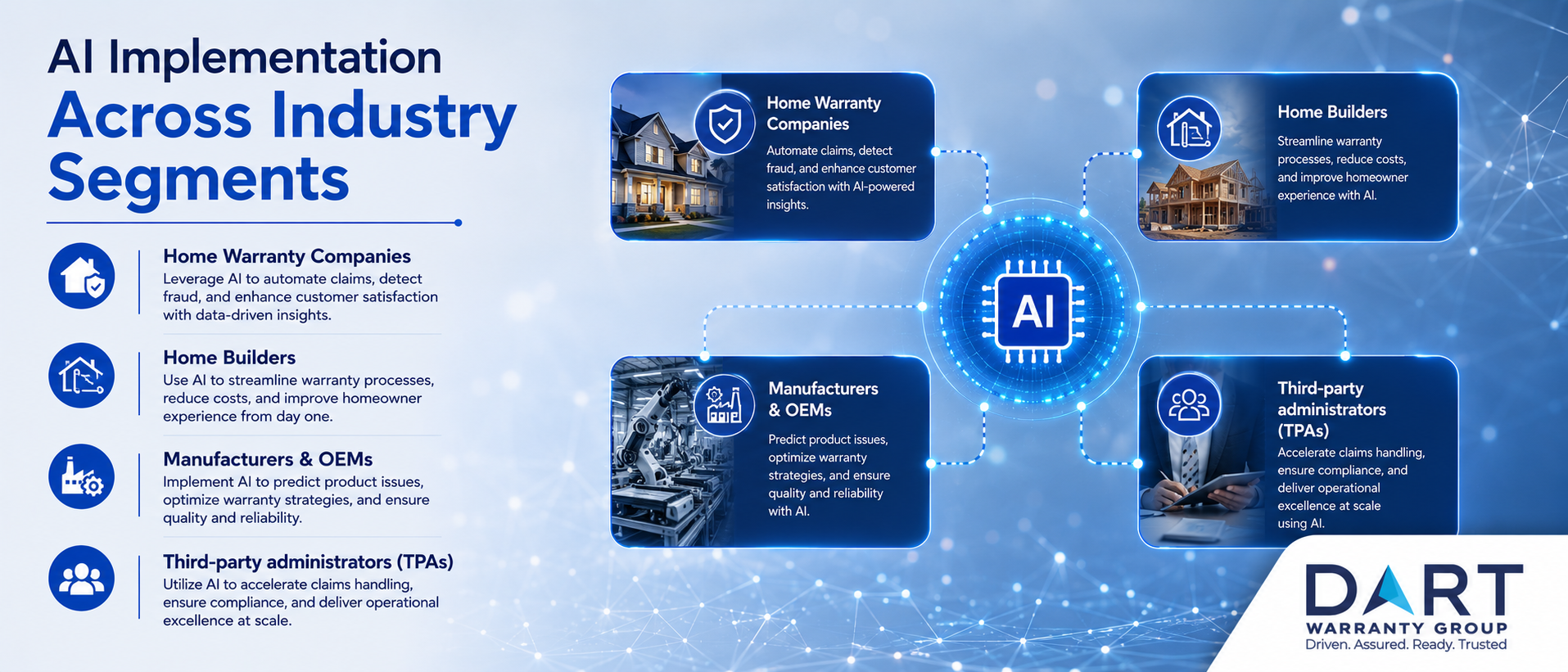
AI adoption varies across different warranty industry segments, and each faces its specific set of challenges and opportunities. Now let’s look at it:
Home Warranty Companies
Home warranty companies are really ramping up their use of AI. With such high volumes of claims for things like HVAC systems, plumbing, and appliances, these providers are at the forefront. They have several key applications, such as auto-adjudication, smart dispatch, chatbot-driven claim intake, and fraud detection. Thanks to AI, many companies notice their claim resolutions speeding up by 40-50%, and customer call volumes dropping by 30-50%.
Home Builders
Home builders have a big AI opportunity ahead of them, although only around 14% of major players are using it. Builders can benefit from improved claim management over those long warranty periods, accurate contractor routing, and community-level quality analysis. Besides, adding automation also boosts homeowner satisfaction, which is key for a strong market position and reputation.
Manufacturers & OEMs
Ultimately, manufacturers and original equipment makers (OEMs) have huge data sets perfect for predictive analytics. AI helps predict part failures, assigns replacement costs, and handles auto-authorization for routine replacements. This also ensures consistent warranty coverage globally.
Fact Check: Deloitte notes that using AI for analytics results in an annual drop in warranty claims of 10-15% for manufacturers. The largest segment of the AI warranty analytics industry is manufacturing, where AI reduces warranty claims by 10–15% annually, according to Deloitte.
Third-party administrators (TPAs)
Third-party administrators (TPAs) handle various warranty programs, so AI is key for handling all that efficiently. The automotive sector is particularly advanced here. TPAs use AI in several ways, such as creating rules engines for automation, spotting fraud, predicting costs, and optimizing service networks. In vehicles, they also tap into telematics and repair info to make their models super accurate.
The Integration of Human Expertise and AI
Claims processing in the future is not only about machines, but about the perfect blend of artificial intelligence and human insight. While sophisticated claims automation can do the challenging tasks, human expertise provides depth, compassion, and supervision for complex cases.
The best modern warranty software reflects this collaborative dynamic in three different levels of maturity:
Stage 1: AI Assistance
The first phase is to use the AI as a digital co-pilot for human adjusters. When a claim is entered into the warranty claim management software, the system will automatically scan the documentation, flag potential errors or missing data, and compare it against policy guidelines. It takes the boring administrative work out of the process, so human teams can focus on validation and closing the claim.
Stage 2: AI Recommendation
As more historical data is collected by the system, it evolves from being just an assistant to becoming a consultant. For example, in the field of auto warranty software, it could examine the notes made by mechanics and the costs of spare parts before making suggestions whether to approve, deny, or investigate claims of fraud. The humans still maintain all responsibility for decision-making.
Stage 3: AI Auto-Adjudicate
The highest level of AI application in warranty management systems would be the process that involves no human input. This stage is possible for normal or low-risk cases like routine replacement of components in an extended auto warranty system, where auto-adjudication takes place immediately.
Let’s wrap it up
Hopefully, the above-mentioned detail is adequate to understand warranty management and the role of AI in warranty management software. After the detailed discussion on warranty management, we can clearly mention that AI is not just making warranty management better; it is changing it completely. In 2026, companies that use AI for managing warranties are getting ahead of others because they are more efficient, make fewer mistakes, and give customers a better experience. They automate claims and use data to predict what might happen next.
Now, the question of whether or not to employ AI is no longer relevant. How fast can you start using it so you do not fall behind in a market that is changing fast? Tell us what you think about it.
FAQs
1. What is AI in warranty management software?
AI helps warranty management work better by using machine learning and automation. This makes warranty processes easier, more accurate, and less expensive.
2. How does claims automation improve warranty management?
Claims automation makes it faster to process claims. It also reduces mistakes made by people. This makes the whole process more efficient.
3. What is auto warranty management software?
Warranty management software is a system. It handles warranty processes for vehicles. This includes checking if the claims are valid and settling them.
4. How does AI help in fraud detection in warranty claims?
AI looks at patterns in claims data. It finds claims that do not look normal. This helps stop people from cheating.
5. What’s extended auto warranty software?
It helps manage warranties. It makes sure claims are handled smoothly.
6. Why should businesses adopt AI-powered warranty management solutions?
Businesses should use AI-powered warranty management solutions. They will save money. Their processes will be faster.
Leave a Reply
Recent Posts





Daniel Kozlowski
Designation: Co-Founder
With over 30 years of experience in the extended warranty and service contract industry, I help businesses modernize warranty operations and optimize claims management processes. As the founder of DRK Resources Tech LLC, I share insights focused on warranty management, service contract solutions, and automotive technology trends.