Daniel Kozlowski
03 Aug 2026
No Comments
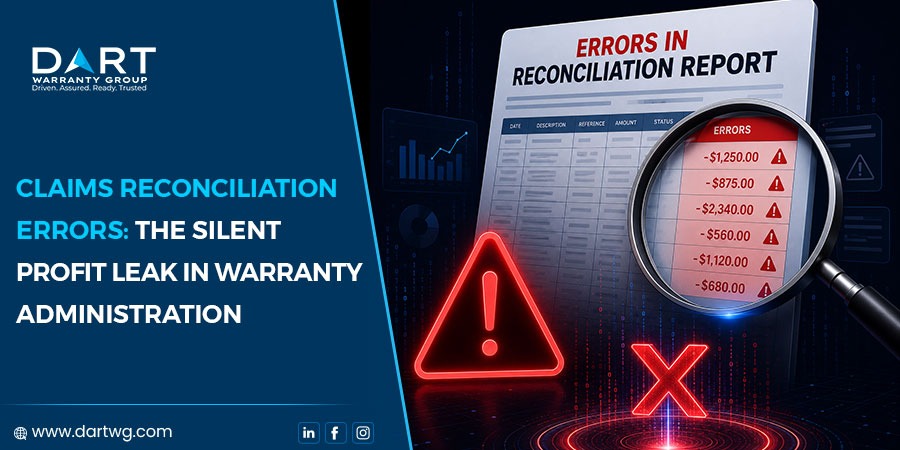
Imagine two spreadsheets that should contain identical information – and don’t. Somewhere in the process from dealer approval to the underwriter’s ledger and to the finance department’s month-end closing process, a few dollars disappear without a trace on every claim. When multiplied by thousands of claims per year, it’s not an insignificant margin. It’s one of the biggest threats to the warranty business, yet it remains almost entirely overlooked: the threat of claims reconciliation error. It doesn’t raise any red flags; it’s not reflected in any major incidents, and it’s probably not going to be shown in a presentation to the board, yet it bleeds margin every month right there in your spreadsheets, disconnected systems, and manual approval processes. This is a leak that never gets budgeted for and no matter how good the warranty claim management software is, it cannot fix the process that creates the leak.
What Exactly Is a Claims Reconciliation Error?
In warranty administration, reconciliation is the procedure of reconciling the amount approved, the amount paid, and the amount that was actually due in relation to claims administration, third-party payers, repair shops, and company ledgers. Any discrepancy in these amounts is considered to be a reconciliation problem.
Common examples include:
- An item that receives double reimbursement because of duplicate submission.
- The wrong labor rate used for billing based on the approved guideline.
- A component charged a different markup or cost category than intended.
- An item that is billed as “closed” on one system but “open” on the other.
- Inconsistent dates of approval and payments.
All in all, such incongruencies appear minor on their own. However, viewed collectively, among the huge volume of claims processed, they mean real money that can be recovered.
Where the Leak Actually Happens?
A reconciliation problem is not usually a result of one particular reason. It is usually a result of cumulative process shortcomings over time.
Some common reasons for problems with the reconciliation process include:
- Duplicate submissions from repair centers operating through multiple portals
- Manual data entry across separate systems
- Varying labor-time guides used differently by region or individual reviewer
- Mismatch between part numbers on repair receipt and payment portal
- Delays in updating claim status leaving claims “open” after payment
Many companies do not even see their claims come into contact with their general ledger, and when they are passed through emails, PDFs, and spreadsheets, they are vulnerable to being missed or counted twice.
The Real Cost: More Than Just Dollars
The financial impact is the headline, but it’s not the entire story.
What reconciliation errors actually cost a warranty program:
- Manual investigation and back-and-forth emails cost staff hours
- Delayed vendor payments that strain dealer and repair-shop relationships
- Audit exposure from discrepancies identified in compliance reviews
- Eroded trust between administrators, dealers, and underwriters
- Reputational damage when an internal data mismatch causes a customer’s coverage dispute
Left unaddressed, these small discrepancies compound into audit nightmares, partner relationship stress, and a warranty program that on paper looks profitable but in practice bleeds margin.
Why Legacy Processes Can’t Catch These Errors?
Reconciliation by hand requires someone realizing that there is a discrepancy between the two figures, which human beings obviously cannot scale to check thousands of monthly claims. Spreadsheet software will not automatically detect duplicate IDs in claims. Approvals via email do not link in real-time with the accounting system for payments.
The shortcomings of traditional approaches:
- A single source of truth for claim status across every stakeholder
- Automatic duplicate detection at the point of submission
- Real-time visibility into approval-versus-payment gaps
- An audit trail that doesn’t rely on someone remembering an email thread
That is exactly what specialized warranty claims management software addresses. By consolidating all the information regarding the intake, approvals, and payment of the claims in one place, this type of software removes the blind spots that allow for mistakes to go unnoticed, offering a real-time overview of all the processes to the finance and operations departments.
The Auto Warranty Problem Is Its Own Beast
Vehicle service contracts add layers of complexity that generic claims systems weren’t built to handle.
Complexity unique to vehicle service contracts:
- VIN-specific coverage terms that vary contract to contract
- Labor-time guides that differ by repair type and manufacturer
- Parts pricing that fluctuates by region and supplier
- Dealer networks submitting claims in inconsistent formats
It is in this situation where the need for specialized auto warranty management software comes into play, using the application of coverage policies, labor guidelines, and pricing policies right at the time of claim filing and not afterward. It is much more difficult to recover funds when the process of reconciliation has occurred after payment and not before.
Bringing Consistency to Auto Warranty Claim Management
Consistency is the solution to reconciliation drifting. Good management of automobile warranties is contingent on all claims, regardless of where they came from, whether dealerships, repair centers, or whatever regions, being assessed based on the same principles of coverage, labor rate charts, and audit trails.
Three pillars of consistent claim handling:
1. Standardized intake — every claim enters through the same validation gate
2. Uniform pricing logic — the same labor and parts rules apply network-wide
3. Centralized audit trail — one history, visible to every stakeholder
However, without such consistency, the process becomes a guessing game where two departments, although technically dealing with “the same” claim, see very different versions of it. The only way to make reconciliation not an event but rather just something routine would be to standardize claim intake and validation procedures across the whole network.
Automation as the Real Fix, Not Just a Buzzword
The best way to prevent reconciliation errors isn’t to catch them faster – it’s to prevent them in the first place. That’s the promise of efforts to automate claims processing.
What effective automation looks like in practice:
- Claims data validation at the time of entry
- Spot duplicates before they get paid, in real-time
- Matching payments to approvals in real time, not at month-end.
- Routing exceptions to a human only when genuine judgment is needed
Automation doesn’t take people out of the process; it takes out the repetitive, error-prone busywork so that the people involved can focus on the claims that actually need a decision.
Why AI Is Changing the Reconciliation Conversation?
Rules-based automation can catch known patterns, but claims data is messy in ways static rules can’t always predict. This is where AI in warranty management is beginning to make a measurable impact.
Where AI adds value on top of static rules:
- Learning from historical claims data to flag anomalies that don’t fit expected patterns
- Predicting claims likely to lead to disputes before they become serious
- Continuously improving fraud and error detection without manual rule-writing
- Catching anomalies on entry before they ever make it to a ledger
Extended Warranty Programs Face the Same Exposure
It is not just car warranty companies that face this problem. Warranty companies for homes, electronics, and equipment also run into these same difficulties with regard to reconciling claims when the data is stored separately.
AI-Enabled Automotive Warranty Software Built for Modern Businesses
Discover More →Where the exposure occurs by line of products:
- Home warranty companies working with different contractor systems and invoices
- Electronics protection plans, where SKU and replacement cost information changes rapidly
- Equipment service contracts with different manufacturers and parts vendors
- Multi-product administrators overseeing several warranty product types in separate legacy systems
The solution, provided by today’s advanced extended warranty software, is to bring together all claims, payments, and coverage parameters regardless of the product line and administrator. The lesson learned here is identical in each warranty vertical – fragmented systems generate fragmented information.
A Regional Snapshot: Why Location-Specific Demand Matters?
Warranty administrators on the hunt for auto warranty claim management software in USA are discovering more and more that off-the-shelf systems do not take into consideration state-specific regulation compliance, regional labor rate variations, and dealer network density in each market.
Why “one national average” isn’t good enough:
- State-specific regulation issues impacting coverage and timing of claims
- Labor rate variations by region not captured by pricing table averages
- Dealer network density causing dramatic differences in claim volumes by city
- Dispute behavior unique to each locality averaged away by national benchmarks
In cities with high dealer density in the automotive sector, the hunt for auto warranty management software in Chicago is emblematic of the larger trend: dealers want a system that recognizes regional claim volume trends and will scale with their expanding dealer network.
Scaling Reconciliation Accuracy Across the Country
However, as warranties increase in quantity, the complexity of ensuring that each one is properly reconciled increases too. Warranty claim management companies that process auto warranty claims in USA have come to realize that reconciliation is far from being something they can do and then not worry about anymore.
What scaling reconciliation actually requires:
- Constant surveillance and not one-time check-ups
- Consistency in terms of rules despite state and region
- Investment in reconciliation processes as the number of claims increases
It is those companies that treat reconciliation as an everyday process that will manage to maintain their margins as they scale.
The Local Efficiency Play
With respect to the benefits of automated claims processing in Chicago, the value proposition may be seen in terms of speed and accuracy in large numbers.
What that value proposition includes:
- Increased speed of payment for dealers, decreasing friction between repairers and claims handlers dealing with large volumes
- Reduced touch points, meaning reduced opportunities for numbers to fall through the cracks
- An automated reconciliation system that scales with regional claims volume
- A competitive advantage in markets where dealers have options with respect to choosing their warranty administrators
This is not just an economy play with regard to automation – it is also a competitive advantage in markets where dealers can select their warranty administrators.
Building a Reconciliation-Proof Process
Solving the reconciliation gap is about following a few disciplined practices:
- Consolidating claims information in one system of record instead of in emails and spreadsheets.
- Automatically validating coverage and pricing criteria at the time of submission.
- Daily reconciliation of payment vs. approval instead of monthly.
- Implementing exception processing to save staff’s time on real issues instead of on matching.
This does not mean that people need to be taken out of the process; it means they should be empowered with proper information.
Let’s wrap it up.
There will not be any single disaster that can proclaim a claims discrepancy problem. It will grow gradually with every claim until the day comes when a perfectly good warranty program turns out to be losing money.
The takeaway, in short:
- The leak is quiet and cumulative, not a single dramatic event
- Manual reconciliation can’t scale against modern claim volume
- Automation and AI catch errors before they become losses
- Consistency across dealers, regions, and product lines is what makes it stick
The solution does not lie in manual audits; it lies in infrastructure that prevents losses before they happen. The DART Warranty platform is designed on just this premise, providing the automation and centralized claims infrastructure needed to prevent the losses, not try to fix them afterwards.
Also Read: The Real Cost of Slow Claims Turnaround Isn’t Just Time. It’s Lost Profit
Frequently Asked Questions
1. Why do claims reconciliations go wrong in warranty administration?
The reason lies in the disconnection between systems, with claim information that travels by email, spreadsheets, and other systems instead of being centralized in one place. This problem is solved precisely by a specialized warranty claim management system.
2. In what way does automation minimize the number of warranty claim discrepancies?
As claims are automated, duplications, price inconsistencies, and problems of approval versus payment are detected right away, not a week later during an audit procedure.
3. Why does the automotive warranty provider require specific software rather than a generic one?
Since car warranties use VIN-specific policies and labor time guidelines, as well as regional pricing for parts, generic software cannot solve the problem of errors.
4. How is AI used in detecting warranty claims mistakes?
AI in the area of warranty management recognizes patterns in past claims and predicts potential disputes and anomalies, something that cannot be done by a static rule-based system.
5. Is reconciliation only an issue for automobile warranty schemes?
No, since any warranty company using extended warranty software, whether it is for home, electronics, or equipment warranty programs, is at risk of experiencing the problem of reconciliation when claim and payments information is kept in different systems.
6. How does the amount of regional claims influence the precision of the reconciliation process?
When considering warranty management software in Chicago or any other region with a lot of dealerships, companies will want to use a system able to process many regional claims and still provide accurate reconciliation across the country.
Leave a Reply
Recent Posts





Daniel Kozlowski
Designation: Co-Founder
With over 30 years of experience in the extended warranty and service contract industry, I help businesses modernize warranty operations and optimize claims management processes. As the founder of DRK Resources Tech LLC, I share insights focused on warranty management, service contract solutions, and automotive technology trends.