Daniel Kozlowski
01 Oct 2026
No Comments
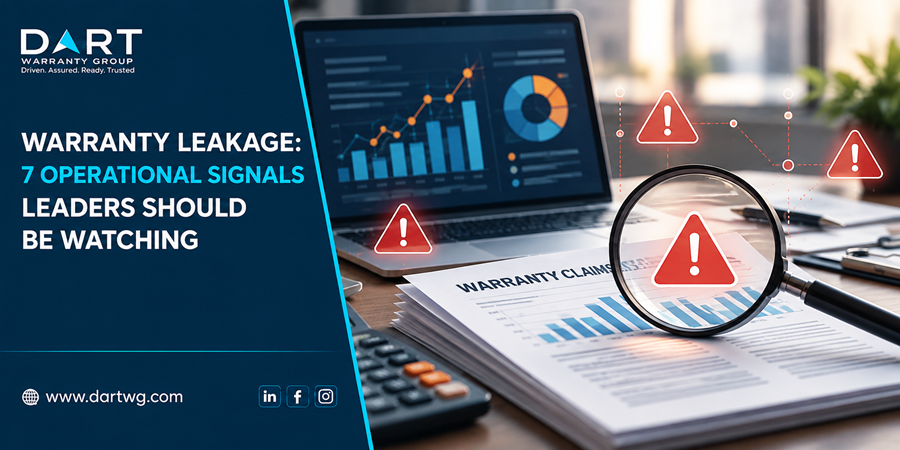
No warranty program is without its own leakage, but most managers never discover this until the figures no longer add up. There is an approval for a claim that should not have been. There is a customer who waits three weeks for a reply when it should take only three days. And most significantly, there are dealerships who quietly eat the costs that should be reimbursed to them. On their own, none of these situations look critical. But collectively, they represent warranty leakage, which is possibly the most costly issue lurking right under our noses in the service, automotive, and equipment industries today. If your people are still using spreadsheets and emails for warranty claim management, you can bet that you are leaking money; you just do not know it yet.
What Is Warranty Leakage, Really?
Warranty leakage, in its simplest sense, is the slow, mostly invisible leakage of revenue and inefficiency due to lack of control in the processes of warranty and claims management. This will be seen in terms of overpayment, lost recoveries from vendors, duplicates that are processed, and delays, which will drive customers to complain and cause customer turnover. This is not an obvious failure; it is multiple failures compounding every month.
The challenge is that warranty leakage is always stealthy. It does not come in the form of “warranty leakage” in any profit and loss statement. It resides in claims processing times, the accuracy of approvals, and the customer satisfaction score. This is precisely why operations managers must understand which signs to look for before the problem becomes an obvious problem.
Why Warranty Leakage Quietly Drains Profit?
Compound consequences of leakage. An unnoticed error can be worth just hundreds of dollars. Add up such expenses for thousands of claims per year, and you get six-figure or even seven-figure losses that could have been avoided. Not only does leakage cause financial damage, but it also affects relationships with suppliers, delays payments for work done by technicians and dealers, erodes customer trust, and makes audits a difficult task. Companies not practicing automated claims processing do not know how much money they are losing through manual processes until they make a comparison with a company using modern technology.
The 7 Operational Signals Leaders Should Be Watching
1. Claims Processing Times Keep Creeping Up
If it has been creeping up every quarter without anyone being aware, it’s probably not a staffing problem but a process problem. More time in a cycle creates more chances for human error, more workarounds, and frustrated customers. Monitor this KPI on a monthly basis, not an annual one, since the leakage gets away from you before you know it.
2. Manual Data Entry Errors Are Piling Up
With each written version of an assertion from one database to another, whether from the ticketing system into the warranty system or from the warranty system into the spreadsheet, there is always room for error. This would be evidenced by things like mismatched VINs, incorrect part numbers, and duplicated entries, which is just one example of when a manual process has exceeded its capability. It is at this point that any company should be considering an upgrade to auto warranty claim management software.
3. Disconnected Systems Are Creating Blind Spots
With disconnected systems such as your CRM, work order database, and warranty log, the entire picture is impossible. Approvals are made without referencing past repairs. Fraudulent trends can not be detected because there is never an integrated view of the customer experience. This is not just a minor problem; disconnectivity is a huge hidden contributor to leakage.
4. Approval Rates Don’t Match Historical Patterns
If there is a sharp change in approval percentages that is not linked to any business reasons, this is something that should be investigated. There may be a new employee who has been too generous in granting approvals, an organized group of fraudsters who have managed to exploit a weakness in your approval system, or maybe the criteria for eligibility have become out-of-date due to new products/terms being offered.
5. Customer Complaints About Claim Delays Are Rising
The complaints are rarely about the terms and conditions but rather the time it takes for them to be addressed. An increase in the number of delay-related complaints is a clear indication that there is strain on your internal process, and it usually comes before any outward indication of a leaking process.
6. Fraud and Duplicate Claims Slip Through
If there are no automated checks to ensure that the same claim is not being submitted again but with slight changes in information, then a claim may even be filed for services that were not provided at all. The greatest impact made by AI claims automation in USA warranty processing operations comes from pattern recognition, which would not be missed by a person reviewing hundreds of claims each week.
7. Contract and Agreement Terms Are Hard to Track
However, warranty leakage goes beyond just the claims process; it has everything to do with the underlying agreements behind those claims. Should it be difficult for your team to access coverage details, dates of renewals, or the responsibilities of suppliers, you are always making decisions with partial information on the table. And that is why you need a modern agreement management system to supplement your claims solution.
How Leaders Are Closing the Leak?
Moving From Manual to Automated Claims Processing
Organizations that have made the greatest strides in dealing with leakage are not those that are spending the most money; it’s those that are being more efficient with their spending. Eliminating the review chain process that is based on people creates efficiencies where most mistakes happen. Automated validations, standard intake forms, and monitoring progress all create efficiencies.
The Role of AI in Claims Automation
In addition to automation, there is intelligence that goes beyond the limitations of static rules. This involves detecting abnormalities in several thousand claims at once, predicting which claims will have disputes, and learning from past trends. When companies review their agreement management software in the USA and choose one out of many options available today, what differentiates one product from another depends on the integration of its AI rather than just having the technology as an option.
AI-Enabled Automotive Warranty Software Built for Modern Businesses
Discover More →Why Agreement Management Belongs in the Same Conversation?
Claims and agreements go together like hand in glove. A claim is legitimate only if it corresponds to the conditions of an existing agreement, and the conditions change more frequently than most teams manage to record manually: new supplier agreements, updated tier levels of coverage, and regulations specific to particular regions. Integrating claims management and agreements management on one platform will eliminate one of the major leakage risks: making decisions with incomplete information about existing conditions.
Regional Considerations: What US Businesses (and Chicago Dealers) Should Know?
Warranty and service policies may differ in different regions. Due to the variety of consumer protection laws at the state level, differences in regional networks of dealerships, and specific supplier deals, a universal approach to claims may fail when applied on a large scale. The same is true for the evaluation of a warranty management system in a dealer network in Chicago, where there is a need to consider state-specific peculiarities of consumer protection and multi-location claims management that would otherwise go unnoticed by a universal scheme. When studying auto warranty management software in USA, companies should pay attention to the flexibility of the platform.
Building a Warranty Program That Does Not Leak
Warranty leakage prevention is not a one-off exercise; it is a continuous process of operation. The companies that have done well with warranty leakage prevention use their claims and agreements data as one system, monitor their operations on a monthly basis instead of an annual basis, and use automation and AI as a solution rather than as a technology trend that was not designed for manual work.
If you find even just two out of these seven signals familiar, it’s high time you took a closer look at your operations before the losses become more serious. The earlier the leakage is identified, the less it costs to fix it.
Final Words
Warranty leakage does not correct itself, nor does it ever stay small. On the bright side, however, each of these indicators is quantifiable, manageable, and most importantly, repairable with the right framework in place. This is precisely what Dart Warranty exists to provide: a single platform to connect claims handling, agreement management, and AI to detect warranty leakage early, before it affects margins, rather than after. If your team is prepared to take a proactive approach to identifying warranty leakage in the first place, then Dart Warranty is here to help you prevent it.
Also Read: How to Choose the Right Warranty Management Software: 12 Questions to Ask Before You Buy
FAQs
1. Can you define warranty leakage in layman’s terms?
Warranty leakage refers to the continuous and unnoticeable monetary loss resulting from inefficiencies or inaccuracies in the warranty claims process, such as overpayment, duplicates, late claims processing, and under-recovery from suppliers.
2. How do I know if my company is experiencing warranty leakage?
If there is a growing trend of long claim cycle times, approval rate discrepancies, complaints regarding delays in the process, and manual input errors, then there is a high chance of warranty leakage.
3. Is automation capable of reducing warranty leakage?
Indeed, the automation of the claims process eliminates many manual touchpoints, as well as the use of artificial intelligence-based tools to uncover any fraud or inconsistencies in the process.
4. Is warranty claims management software distinct from agreement management software?
They play different but interrelated roles. While claims management software oversees the management of warranty claims, agreement management software is used to monitor the terms of the agreements that define whether or not a warranty claim can be made.
5. Are there any regional issues involved in selecting warranty management software?
Certainly. The regulations, dealership networks, and compliance laws will vary by state in the United States, so the software must be adaptable to regional issues rather than forcing each state to use the same process.
Leave a Reply
Recent Posts





Daniel Kozlowski
Designation: Co-Founder
With over 30 years of experience in the extended warranty and service contract industry, I help businesses modernize warranty operations and optimize claims management processes. As the founder of DRK Resources Tech LLC, I share insights focused on warranty management, service contract solutions, and automotive technology trends.