Daniel Kozlowski
21 Aug 2026
No Comments
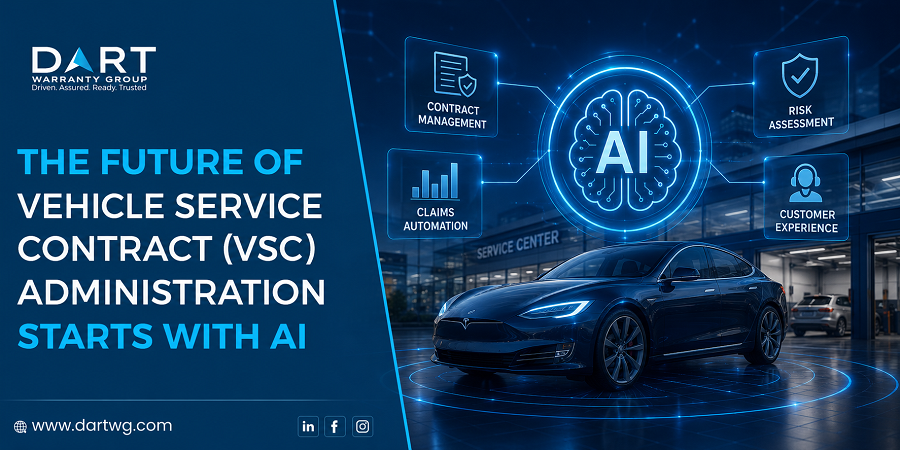
All industries will eventually come to a point when the old ways of doing business become incapable of keeping pace with their own magnitude, and VSC administration has finally reached this point. For decades, this business operated in an environment dominated by filing cabinets, fax machines, and a large number of employees copying the same information into different systems. And it all worked due to the fact that the volume of the work could be handled and the customers were patient enough. But this is no longer the case today: dealerships now produce thousands of contracts each month, claims come day and night, and the regulatory bodies demand a certain accuracy in the paperwork that was never intended to be achieved using spreadsheets. Into this mix comes artificial intelligence, not as some sort of futuristic tool, but rather as the infrastructure that the whole industry has been waiting for.
This particular point in time differs from previous waves of “digital transformation” in that AI is not just digitizing the traditional paper-based process but rather redefining it. Rather than software systems that store contracts and leave decision-making processes to humans, AI technology today analyzes contracts, detects any mistakes, predicts the future, and does all that before anything needs to be done by an actual person. This shift in focus – from mere storage to actual intelligence is what is behind the future of Contract Management Software, and this is what makes VSC providers, dealers, and administrators reconsider their current solutions. It will be providers that embrace this concept early that will not only benefit from saving time, but also completely redefine the way their business works in terms of speed, accuracy, and scalability.
Why VSC Administration Needs a Digital Overhaul?
Traditionally, VSC administration is highly dependent on spreadsheets, email chains, and legacy systems. As a result, the renewal notices do not reach on time, the claims process takes several days, and the dealer has difficulties in identifying which agreement is still valid, which is expired, and which is pending approval. Such fragmentation leads to several internal problems, as well as to issues that arise on the side of the end client, who expects timely and clear services.
As the volume of transactions increases, the manual way of work can no longer cope with the task. In this case, there should be an Agreement Management System in USA, where all the terms and conditions of each agreement will be stored centrally, easily accessible in real time.
The cost of maintaining the manual system is not evident at first sight. The loss of one renewal notice seems to be an insignificant error. However, the loss of thousands of renewals results in lost revenue, customers’ frustration during car breakdowns, and other negative consequences. In addition, non-compliance with regulatory requirements is much more expensive because the requirements for VSC vary greatly from one state to another.
How AI Is Transforming VSC Administration?
Contrary to digitization, artificial intelligence goes further and enhances the process of decision-making at all stages of contract management. Here are a few examples:
- Smart Contract Creation and Evaluation
Modern AI-based models have the capability of analyzing the text of the contract, detecting potential issues within a few seconds. Instead of having a compliance officer go through each and every point of a contract, CLM software in the USA evaluates the contract for any missing clauses, expired pricing, and/or non-compliance using natural language processing capabilities.
- Proactive Claims Management
By analyzing historical claims, machine learning models can predict the probability of future claims and their costs. Thus, administrators will be able to adjust VSC plan pricing and avoid potential fraud cases.
- Automated Renewal & Expiration Processes
One of the most cumbersome aspects of VSC management includes keeping track of renewal periods. AI-driven solutions can automatically remind about the upcoming expiration periods, alert relevant parties, and even help start the renewal process, thus preventing any lapses of insurance due to human negligence.
- Enhanced Dealer Onboarding Process
The dealer network is a dynamic one, and every addition of another dealer means signing an agreement. A properly designed dealer agreement system in the USA makes use of AI to pre-fill forms, check licenses of the dealers, and facilitate their signing using electronic signature tools.
The Role of Contract Lifecycle Management in the AI Era
A VSC, throughout its life cycle from inception to cancellation, passes through certain stages: drafting, negotiating, executing, servicing, renewing, and ultimately settling or payment of the claims. The manual management of the lifecycle of a VSC poses risks of delays and non-compliance in all stages involved.
It is in such a scenario that an Auto Contract Lifecycle Management system comes in handy. Through such a system, it becomes possible to put together all the stages in the lifecycle of the VSC under one roof, and administrators get the information on where an agreement is within the entire process, who will act next, and the average time each stage takes.
Example: A Multi-State VSC Provider
Think about a VSC administrator that operates in 30 states and has many dealers as partners. Previously, using a lifecycle management solution powered by AI, a contract was processed within 12 days, with mistakes regarding compliance being quite common because of varying regulations in each particular state. Now, after adopting an automated lifecycle solution, the processing time fell to less than 3 days.
Warranty Management: The Other Half of the Equation
However, the process does not end there. VSC management also includes the provision of warranty servicing, claim verification, and repair approval. This is an area that requires the specialized services of Warranty Management Software.
Contemporary warranty systems utilize AI to match claims with the contract details and automatically send out those claims that meet the terms of the contract for payment processing. The entire process takes hours instead of days and benefits dealers as well as consumers.
Key Benefits of an AI-Driven Warranty Management System
- Faster claims processing — automatic verification according to contract terms
- Detection of fraud attempts — pattern detection identifies dubious claims
- Enhancement of customer confidence — visibility of claims process in real time
- Reduction in administration — fewer points of contact for each claim
An efficient warranty management system does not exist alone; it must be integrated with the contract database to ensure all decisions are made in accordance with the actual contract terms.
AI-Enabled Automotive Warranty Software Built for Modern Businesses
Discover More →Core Features to Look for in AI-Powered VSC Platforms
Some of the top features for an updated platform include the following:
- Centralized document management system — all contracts, amendments, and disclosures kept in one location
- Compliance rules engine — compliance checks that adjust according to state regulations
- Real-time dashboard — overview of contract status, claims volume, and renewals
- E-signature process — quicker contract processing without printing or scanning documents
- API integration — seamless exchange of data between dealerships, underwriters, and claims administrators
- Predictive analytics — ability to forecast claim expenses and flag high-risk contracts
The Business Case: Why This Matters Now?
For dealers and administrators who hesitate to embrace automation in back-office systems, there will always be competition that offers a greater customer experience, with faster approvals, better pricing, and quicker turnaround times. The cost of manual mistakes such as failed renewals, incorrectly priced contracts, and delayed claims becomes substantial in a large portfolio. In most cases, the quickest way to address this challenge would be through adopting a specialized Warranty Management System that aggregates pricing, claims, and regulatory data from disparate systems into one place.
However, investing in proper infrastructure is not just an efficiency but a scalability issue too. With growing networks and increasing volumes, only AI-driven and automated systems can sustain accuracy and speed without adding proportionate headcount.
There is also the aspect of talent to think about. Finding good compliance and claims officers is not an easy task, and monotonous jobs tend to demotivate the people involved very easily. Through automation of the tedious aspects of contract verification and renewal and claims validation, AI allows for the more complicated tasks that need the involvement of trained professionals to be dealt with more efficiently. This way, a system that can expand easily without increasing the number of employees is developed.
What the Future Holds?
In the future, we should see AI used for VSC administration go past automation and into full decision support. Future software solutions would feature:
- Assistant AI that will allow staff to ask questions about the contracts in natural language
- Dynamic pricing engines that would calculate VSC prices based on vehicle risk profiles in real-time
- Better integration between the DMS, the underwriting software, and the claims processor
- Automated self-updating compliance engine that would keep up with changing laws
The early adopters of these technologies will be the ones in the best position to deliver quick services, reduced costs, and high client retention.
Final Thoughts
The future of VSC administration is not about automating paperwork anymore; it’s about designing smart, connected processes that handle the contract life cycle in advance. From issuance to claims and renewals, artificial intelligence-based systems are converting a tedious and error-prone process into a smarter one with the help of technology.
But the evolution has transformed the goals that administrators pursue while handling these operations. Their performance is not measured based on how fast they can handle paperwork anymore; rather, it is judged according to how precisely they can estimate risks, settle customer claims, and scale the system up with more volume.
It’s the same for the dealers, the administrators, and the underwriters: the future is about using smart technology, and it’s starting right now. Companies like Dart Warranty are enabling companies to make use of this trend already by combining state-of-the-art Contract Management Software with the automation and compliance expertise that VSC administration requires to succeed. The companies that lay this groundwork now will be the leaders of the future.
Frequently Asked Questions
1. What are the purposes of contract management software within VSC administration?
The purpose of this software is to develop, save, control, and administer each process of a vehicle service contract starting from its creation and dealer approval to renewals and changes until the very closing.
2. In what way does an agreement management system in the USA differ from any common documents storage system?
An agreement management system differs from basic file storage because it has such features as state-specific compliance rules, automatic renewal reminders, e-signature capabilities, and audit trails. The agreement management system is developed for specific industries like auto warranty and VSC administration. It is not intended just for storing files.
3. Why does it need CLM software in the USA instead of Excel spreadsheets?
Contract lifecycle management software has the capabilities of automatic contract generation and deadline tracking. Such software can show whether there are any compliance issues and provides visibility. If there are several thousand contracts, a spreadsheet system becomes useless.
4. How does the dealer agreement system in the USA help with onboarding of new dealers?
The dealer agreement system helps in quick onboarding through automatic population of contract templates, validation of licensing and compliance data, and routing of documents for electronic signatures. This enables onboarding in a matter of days instead of weeks while ensuring every new dealer engagement complies with regulations right from the get-go.
5. How is the accuracy of claims improved with auto contract lifecycle management?
Auto contract lifecycle management integrates the entire contract process – drafting, execution, servicing, and renewals – in one automated process. This ensures that claims can be validated based on the terms of the original contract, which reduces disputes and fraud and decreases the time needed to process claims from days to hours.
6. Are warranty management software and warranty management system the same or different?
Although the terms are used synonymously at times, warranty management software usually refers to the software that processes and validates claims, while warranty management system refers to the entire system in which the software runs.
Leave a Reply
Recent Posts





Daniel Kozlowski
Designation: Co-Founder
With over 30 years of experience in the extended warranty and service contract industry, I help businesses modernize warranty operations and optimize claims management processes. As the founder of DRK Resources Tech LLC, I share insights focused on warranty management, service contract solutions, and automotive technology trends.