Daniel Kozlowski
07 Aug 2026
No Comments
Compliance Isn’t Just About Following Rules—It’s About Protecting Your Business
Every warranty organization invests time and resources into building compliant claims processes. Policies are documented. Approval workflows are defined. Audits are scheduled. Yet many organizations continue to face payment discrepancies, inconsistent claim decisions, audit findings, and growing operational risk.
The issue isn’t always a lack of compliance.
More often, it’s a lack of visibility into compliance.
You can’t manage what you can’t see. And in today’s high-volume warranty environment, limited visibility creates blind spots that manual reviews and periodic audits simply can’t uncover in time.
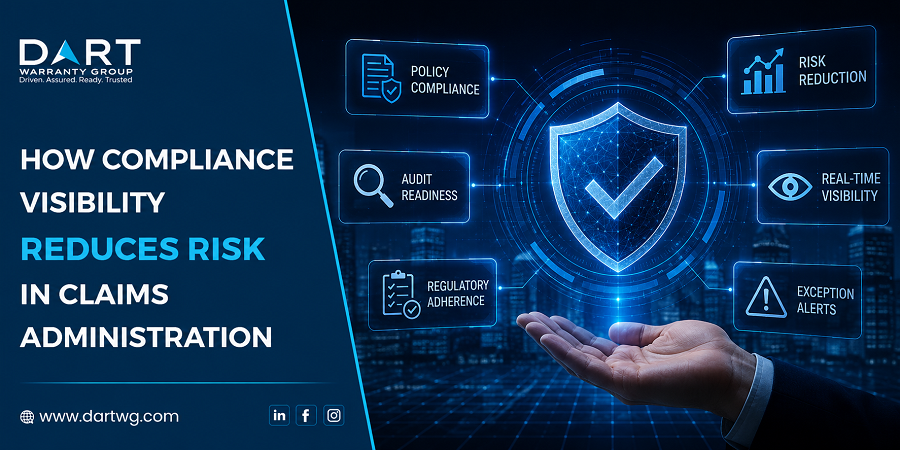
The organizations that consistently reduce risk aren’t necessarily the ones with the most policies—they’re the ones that have real-time visibility into how those policies are being followed across every claim.
The Hidden Risk Behind Every Claim
A warranty claim moves through multiple stages before it’s approved and paid.
- Dealers submit documentation.
- Adjusters review coverage.
- Approvers validate repairs.
- Finance processes payments.
- Reporting teams reconcile transactions.
Every step introduces new data, new decisions, and new opportunities for human error.
When these activities happen across disconnected systems, spreadsheets, emails, or manual approvals, maintaining compliance becomes increasingly difficult.
The result isn’t always a major compliance failure.
More often, it’s hundreds of small inconsistencies that gradually increase financial and operational risk.
Compliance Without Visibility Creates False Confidence
Many organizations believe they’re compliant because they have documented procedures.
But documented procedures don’t guarantee consistent execution.
Consider questions like:
- Are claims being approved according to current business rules?
- Are labor rates consistently applied across every dealer?
- Are policy exceptions properly authorized?
- Can every payment decision be traced during an audit?
- Are duplicate claims being detected before payment?
If these questions require hours of manual investigation, your organization doesn’t have compliance visibility—it has compliance assumptions.
That difference matters.
Why Traditional Audits Aren’t Enough?
Audits have always been an essential part of warranty administration.
But audits are retrospective.
They identify issues after claims have already been processed, payments have been issued, and financial exposure has already occurred.
Modern warranty operations require something different.
Instead of discovering problems weeks or months later, organizations need the ability to identify exceptions while claims are still moving through the workflow.
Real-time visibility transforms compliance from a reactive exercise into a proactive business capability.
The Four Areas Where Visibility Reduces Risk
1. Consistent Decision-Making
When claims are reviewed using standardized workflows and centralized business rules, organizations eliminate unnecessary variation between adjusters, regions, and dealer networks.
Consistency improves compliance while building trust across the entire warranty ecosystem.
2. Complete Audit Trails
- Every approval
- Every modification
- Every payment adjustment
- Every exception
A complete audit trail creates accountability while making regulatory reviews significantly easier.
Instead of searching through emails and spreadsheets, teams can quickly understand exactly who made a decision, when it happened, and why.
3. Early Exception Detection
Small discrepancies often become expensive problems when they’re discovered too late.
Real-time monitoring helps identify:
- Duplicate claims
- Coverage inconsistencies
- Pricing anomalies
- Missing documentation
- Policy violations
- Unusual approval behavior
Addressing these issues before payment reduces both financial leakage and operational disruption.
4. Better Operational Governance
Compliance isn’t only about regulators.
It’s about leadership having confidence in operational performance.
When executives have visibility into claims activity, approval trends, turnaround times, and exception rates, they can make faster and better-informed decisions.
Visibility turns compliance into operational intelligence.
Why Is AI Changing Compliance Management?
Traditional compliance systems rely heavily on predefined business rules.
Rules are effective—but only when organizations already know what they’re looking for.
Artificial Intelligence adds another layer of protection.
Instead of simply validating predefined rules, AI can identify unusual claim behavior, detect emerging patterns, highlight operational anomalies, and prioritize high-risk claims for further review.
AI-Enabled Automotive Warranty Software Built for Modern Businesses
Discover More →Rather than replacing experienced claims professionals, AI helps them focus on the cases that deserve the most attention.
The result is smarter oversight with less manual effort.
Compliance Visibility Is Also a Customer Experience Strategy
Customers rarely think about compliance.
They think about speed.
Transparency.
Accuracy.
Consistency.
Every delayed approval, inconsistent decision, or payment correction affects customer confidence.
Strong compliance visibility creates smoother claims experiences because decisions are faster, documentation is complete, and exceptions are resolved before they become customer issues.
Reducing risk internally often improves customer satisfaction externally.
The Future of Claims Administration Is Transparent by Design
Warranty operations continue to grow more complex.
Dealer networks expand.
Service contracts become more sophisticated.
Regulatory expectations increase.
Manual oversight simply cannot scale with that complexity.
The future belongs to organizations that build transparency directly into their claims operations—not as an afterthought, but as a core capability.
Visibility enables accountability.
Accountability strengthens compliance.
And stronger compliance creates a more resilient, profitable, and trusted warranty operation.
Final Thoughts
Compliance has always been a cornerstone of effective claims administration—but in today’s fast-paced warranty environment, visibility is what makes compliance actionable.
As claim volumes grow, dealer networks expand, and regulatory expectations become more complex, relying on manual oversight and periodic audits is no longer enough. Organizations need real-time insight into every stage of the claims lifecycle to ensure decisions are accurate, consistent, and fully traceable.
By combining centralized data, automated workflows, complete audit trails, and AI-powered insights, warranty providers can move beyond simply meeting compliance requirements. They can proactively reduce financial risk, improve operational consistency, strengthen audit readiness, and build greater trust with dealers, partners, and customers.
At DART Warranty Group, we believe the future of claims administration isn’t just about processing claims faster—it’s about processing them with greater transparency, intelligence, and confidence. Because when compliance is visible, risk becomes manageable, decisions become smarter, and warranty operations become more resilient.
Frequently Asked Questions (FAQs)
1. What is compliance visibility in claims administration?
Compliance visibility is the ability to monitor, track, and verify every step of the claims process in real time. It ensures that claims follow predefined business rules, approval workflows, and regulatory requirements while providing complete transparency and auditability.
2. Why is compliance visibility important in warranty claims administration?
Compliance visibility helps organizations reduce financial risk, prevent policy violations, improve operational consistency, simplify audits, and ensure claims are processed according to established guidelines. It also enables faster identification of errors before they result in costly payments or compliance issues.
3. How does compliance visibility reduce risk in claims administration?
Compliance visibility reduces risk by providing real-time monitoring of claims, standardized approval workflows, automated rule validation, complete audit trails, and AI-powered anomaly detection. These capabilities help organizations identify compliance issues early, prevent financial leakage, simplify audits, and ensure consistent, transparent, and accurate claims processing across the entire warranty lifecycle.
4. What are the biggest compliance challenges in claims administration?
Some of the most common challenges include:
- Manual approval processes
- Disconnected systems and spreadsheets
- Inconsistent claim decisions
- Limited audit trails
- Duplicate or fraudulent claims
- Delayed issue detection
- Lack of real-time reporting
Modern claims administration platforms help address these challenges through automation and centralized visibility.
5. How does AI improve compliance in claims administration?
AI enhances compliance by continuously analyzing claims data to identify unusual patterns, anomalies, duplicate submissions, and high-risk claims that traditional rule-based systems may overlook. This enables claims teams to focus on exceptions while improving accuracy and operational efficiency.
6. What features should warranty claims management software include to improve compliance?
A modern warranty claims management software should provide:
- Configurable approval workflows
- Role-based access controls (RBAC)
- Automated business rule validation
- Real-time dashboards and reporting
- Complete audit trails
- Document management
- Claims reconciliation tools
- AI-powered anomaly detection
- Integration with dealer, finance, and ERP systems
These capabilities help organizations strengthen compliance while improving overall claims performance.
7. How do audit trails support compliance?
Audit trails record every action performed during the claims lifecycle, including submissions, approvals, edits, payments, and exceptions. This creates a transparent history of every claim, making internal reviews, regulatory audits, and dispute resolution faster and more reliable.
8. Can claims automation improve regulatory compliance?
Yes. Claims automation reduces manual errors, enforces standardized workflows, validates business rules, and ensures every claim follows predefined approval processes. Automated workflows also improve consistency, accountability, and documentation across the organization.
9. What industries benefit most from compliance-focused claims administration?
Compliance visibility is valuable across many industries that manage warranty or service contract claims, including:
- Automotive warranty providers
- Vehicle Service Contract (VSC) administrators
- Third-Party Administrators (TPAs)
- Fleet management companies
- Equipment warranty providers
- Manufacturing organizations
- Extended warranty and service contract providers
10. How does DART Warranty Group help organizations improve compliance visibility?
DART Warranty Group provides an intelligent warranty management software platform designed to improve compliance through centralized claims management, configurable workflows, role-based permissions, automated approvals, complete audit trails, real-time dashboards, advanced reporting, and AI-powered insights. These capabilities help organizations reduce operational risk, improve governance, and make faster, more informed claims decisions.
Leave a Reply
Recent Posts




Daniel Kozlowski
Designation: Co-Founder
With over 30 years of experience in the extended warranty and service contract industry, I help businesses modernize warranty operations and optimize claims management processes. As the founder of DRK Resources Tech LLC, I share insights focused on warranty management, service contract solutions, and automotive technology trends.