Daniel Kozlowski
08 Jul 2026
No Comments
Is your warranty system prepared for today’s AI-driven world, or is it still configured to address problems from yesterday?
Well, the fact is that the warranty business is experiencing one of the greatest revolutions in its history. For decades, businesses invested in automating paperwork and warranty claim management processes. Although those systems allowed to significantly boost productivity, they are still based on rigid rules, manual checks, and fragmented processes that do not correspond to modern technological requirements.
This business model is already outdated.
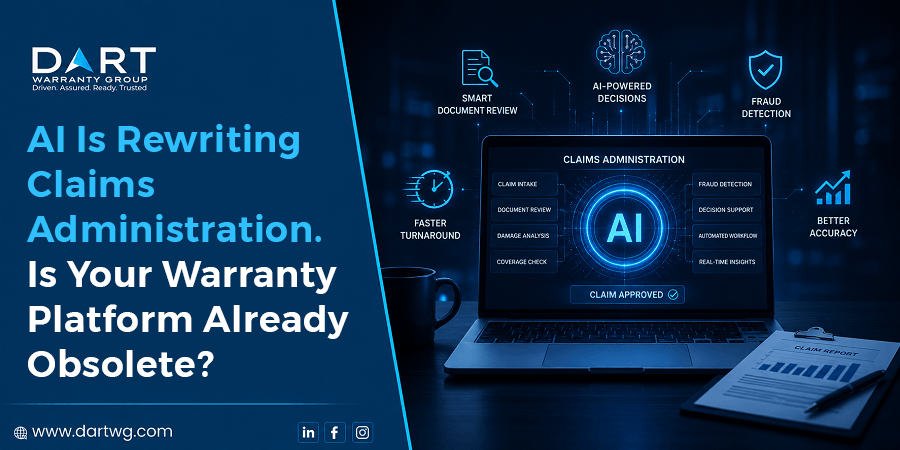
Consequently, the use of artificial intelligence (AI) allows automated decision-making using machine learning, predictions, Natural Language Processing (NLP), and computer vision. Furthermore, modern warranty claim software is capable of evaluating repair documentation, spotting any kind of fraud, making predictions about claim outcomes, providing recommendations on what to do next, and enhancing its skills based on data. With the introduction of EVs, connected products, IoT devices, and other advanced diagnostic technologies, the only relevant question now is whether your existing system can cope with such a change.
The question is not whether AI will transform the warranty management process. It is whether your existing system is designed to work in the new environment or not.
Rising Warranty Costs Are Putting Pressure on Every Business
Costs associated with warranty are increasing with the growing complexity of products. Today’s vehicles contain a lot of software-controlled parts, a battery management system, ADAS (Advanced Driver Assistance Systems), sensors, telematics, and interconnected electronic modules. The same trends can be observed in consumer electronics, industrial equipment, healthcare devices, and business machinery.
The launch of each new part increases the chances of warranty claims automation and makes the verification process harder.
Warranty departments need to consider various factors at once, such as:
- Benefits eligibility
- Terms of Contract
- Labor rate differences
- Parts pricing
- Service bulletins
- Supplier liability
- Versions of the software
- Vehicle/Equipment history
- Past repair records
Manual processing of these parameters causes delays and high costs. Thus, current warranty claim management software in USA is moving from simple workflow tools to intelligent decision support software that can process several inputs at once.
Growing Claim Volumes Demand Intelligent Operations
As more products are manufactured along with increased protection periods, claims on warranties have increased globally. Extended warranty, vehicle service contract (VSC), subscription-based maintenance agreement, certified pre-owned automotive warranty, and service agreements for connected devices lead to claim volumes that are much higher compared to those of traditional warranty agreements.
Such increases impact each phase of warranty management:
- Claims intake
- Contract verification
- Verification of Documents
- Approval to repair
- Investigation into fraud
- Processing payments
- Reporting & Analytics
It is becoming increasingly hard to scale operations solely by hiring more adjusters. Claims experts are expensive to recruit, and labor shortage persists within technical industries.
That is why there is a heavy investment in automating claims processing. With automation, AI helps experts avoid mundane paperwork and concentrate on investigations, dealer support, client interactions, and exception handling.
EVs and Connected Products Have Changed the Nature of Warranty Claims
Warranty claim management in USA has been revolutionized by electric vehicles.
As opposed to traditional automobiles, electric vehicles produce a lot of diagnostics data from their batteries, chargers, thermal components, electric motors, and software.
In the same way, all kinds of connected products produce operational data through IoT sensors and cloud computing technologies.
This is a way for companies to assess:
- Diagnostic trouble codes
- Remote diagnostics
- Sensor readings
- Battery health
- Usage behavior
- Software update history
- Connected service logs
- Predictive maintenance alerts
AI provides the ability for businesses to correlate structured and unstructured data, find correlations in failures, and AI claims processing with use of recommendations.
For instance, an intelligent system is capable of comparing current diagnostic codes with previous repair results, discovering patterns in failures, validating warranty, and recommending claim approval before an adjuster even starts processing that claim.
Customer Expectations Have Permanently Changed
Nowadays, customers evaluate their service experience against digital companies that give an immediate response, clear communication, and up-to-date information.
Waiting several days to get the warranty approved is no longer acceptable.
Customers expect:
- Acknowledgment of claim immediately
- Tracking live status
- Faster repairs approvals
- Digital messaging
- Transparent decision-making
- Predictable timeframes for resolution
These expectations extend far beyond automotive warranties into consumer electronics, commercial equipment, industrial manufacturing, healthcare devices, and home appliances.
To meet these expectations, many enterprises are choosing to automate claims processing across the complete warranty lifecycle. AI-powered workflows reduce manual intervention while improving consistency, accuracy, and turnaround times.
The Next Era of Claims Administration
Artificial intelligence is not only speeding up the current process but is changing the way warranties are being decided. Within the next ten years, warranty claim management in the USA is going to be much more automated, predictive, and data-driven.
Several significant changes have already occurred in this industry.
1. Real-Time Claims Decisions Instead of Multi-Day Processing
Today, typically a mid-complexity warranty claim will go through various operational stages before it is approved:
- First notice of claim
- Contracts verification
- Validation of Coverage
- Repair estimate re;
- Labor Validation
- Analysis of parts pricing
- Fraud evaluation
- Supervisor’s consent
- Notice to Dealer
Despite efficiency, such operations take many days to be completed by even very efficient businesses since each step involves human scrutiny.
However, artificial intelligence and claims management software in Chicago brings all of these steps together into one decision engine.
Machine learning takes into consideration the contract terms, past repairs, part failures, work guidelines, pricing databases, dealer efficiency, and fraud, providing an approval decision in just a matter of seconds.
2. Lower Costs Through Intelligent Automation
Traditionally, increasing numbers of claims would mean employing more adjusters, supervisors, auditors, and support personnel.
Artificial intelligence transforms that economic equation.
Rather than scaling up by adding workers, businesses are now able to scale up through intelligent automation.
Tasks like policy verification, invoice extraction, document categorization, duplication avoidance, correspondence writing, payment processing, and reporting are all tasks that are now capable of being done automatically using modern warranty claims management software systems.
That means that experienced employees can focus on more complicated repairs, fraud investigations, recovery from suppliers, and dealer network assistance.
3. Consistent Decisions Powered by Data
The importance of human expertise will never diminish.
Yet, individual decision-making is intrinsically subject to variations based on workload, experience, judgment, and available information.
Two knowledgeable adjusters dealing with the same warranty claim can have differing views regarding it.
AI mitigates this issue through the implementation of standardized analysis of each claim, based on repair history, supplier quality records, dealer performance, and trends in operations.
Rather than substituting for human expertise, the AI provides a standardized process for decision-making where common claims are subjected to standardized criteria while exceptions get expert attention.
As companies manage millions of claims every year, AI models evolve and become more accurate through continual learning processes.
Why Waiting Is Becoming the Biggest Risk
For many years, businesses have seen AI as something to consider once all their digital transformation efforts were completed. This approach does not work anymore.
With increased complexity and growing customer demands regarding their warranties, postponing AI implementation is now one of the biggest strategic mistakes that warranty vendors can make.
Let’s take a look at the following points:
- Contemporary warranty claims software not only speeds up the process of approval but also constantly learns from every single repair, claim decision, fraud detection case, and customer communication. Old solutions still rely on fixed business rules, providing identical results whatever the product, market situation, or failure types.
- Delayed decision-making has ramifications not just for the claims department but also for a wider range of operations and functions. The warranty management process creates an intricate web of relationships between dealerships, repair facilities, manufacturers, vendors, financial institutions, third-party administrators, and service contract administrators.
- In failing to their claims automation process, the companies allow approvals that should be made in minutes to take days, causing a chain reaction that causes problems in every stage of the service process.
- Organizations adopting intelligent warranty claims management software understand that speed in decision-making involves much more than just efficiency. Intelligent systems not only help organizations develop better relationships with OEMs, dealers, suppliers, and customers through consistency and transparency but also make processes more predictable.
In the era when artificial intelligence transforms the way warranty claims management operates, those organizations that adopt modern solutions today will be able to develop strong partnerships, ensure customer loyalty, and secure their competitive advantage over their lagging competitors.
AI Platforms Learn While Legacy Systems Stay Static
Continuous learning is the biggest strength of artificial intelligence.
Conventional rule-based applications can only be improved by having their business rules updated by administrators. Any changes in labor charges, pricing policies, repair processes, fraud schemes, and product configuration need to be made manually before being implemented in the system.
However, AI operates differently.
The algorithms continuously study past results and operational data to detect patterns that will be difficult for humans to detect in millions of claims. The more claims processed by an AI, the more accurate it becomes because of continuous learning from each claim.
AI can detect patterns such as:
- Dealers consistently outperform on labor hours
- Parts with abnormal failure rates
- Combos for repairs with very high approval rates
- Warranty trends by season
- Fix anomalies in geographic areas
- Supplier-specific quality problems.
This continuous learning process allows AI claims processing to become more reliable and precise over time rather than remaining static.
AI-Enabled Automotive Warranty Software Built for Modern Businesses
Discover More →AI-Native Platforms vs. AI Add-Ons
However, not all the platforms that are claimed to be “AI-enabled” are truly offering intelligent claims management services.
For instance, many legacy providers offer the introduction of AI technology as stand-alone elements on top of their software architecture.
Such technologies might allow automating specific tasks, but in most cases, critical decisions are made using static rules engines and require manual effort.
AI-native software differs substantially.
Artificial intelligence technology is integrated into all phases of the warranty management process: starting from the processing of claims to fraud detection, repair verification, payment, customer communication, and optimization.
This way of architecting makes it possible for intelligence to affect all the decisions rather than separate processes.
Fraud Detection Continues to Become Smarter
This is because warranty fraud changes in accordance with changing repair practices, changing pricing schemes, and new advances in technology. In addition to this, as suppliers change, there are too many factors involved in claims management that simply cannot be managed by a set framework.
Static rules that detect warranty fraud cannot adapt to these changes fast enough.
Artificial intelligence analyzes the behavior patterns based on millions of previous transactions to find any irregularities.
The modern models of artificial intelligence can recognize:
- Uncommon repair rates
- Suspicious dealer collaboration
- Duplicate submission of invoices
- Abnormal use of labour
- Repeated component failures
- Clusters of geographic fraud
- Irregular repair schedules
While existing rule-based systems can only recognize predetermined situations, the AI can recognize new fraudulent trends that emerge.
This enhances fraud prevention while minimizing the occurrence of false positives that affect legitimate dealers and customers.
The Most Costly Error in the Industry Right Now: Build vs. Buy
Since artificial intelligence is becoming a key component of warranty management, organizations have a vital strategic choice to make. Should the organization invest in its own AI solution or adopt one that already exists?
Developing AI capabilities for claims is not a challenge of software development, but it is one of data, expertise, and model operations. And that is a big deal.
When an internal team develops an AI solution for their claims, they tend to handle the first iteration pretty well.
They build a model based on past decisions, combine a few things, and implement the model. In six months, the model drifted so that the patterns of failures it was trained to detect no longer correspond to those prevalent in the current automobile fleet; prices have changed, and the signs of fraud that it recognizes have changed. They need to update the model, but whoever built the model has moved on to something else.
And the cost of keeping claims AI in production- the infrastructure, data pipelines, monitoring, training cycles, compliance changes, integrations- is twice as much as the initial cost of building the thing. Most internal teams do not have the headcount necessary to handle that. Most internal teams only realize this after they have already got themselves in it.
Besides, the purpose-built platform alters this calculation entirely. The models have been pre-trained on industry-specific data, actual vehicle reliability patterns, regional pricing of parts and labor, and adjuster performance histories across thousands of claims operations. The integrations exist. The compliance structure exists. The retraining system exists. You aren’t creating any of this; you are merely setting it for your business rules and turning it on.
More importantly, you get to take the benefits of every other customer on the platform. Every time the group of claims operations operating on a common platform generates a new pattern of fraud, a new set of failure data, a new benchmark for pricing, everyone gets to benefit.
The following factors are essential for successful AI warranty claim management:
- Historical Claims Data Sets
- Data engineering pipelines
- Machine learning expertise
- Feature extraction
- Validation of Models
- Continuous monitoring
- MLOps automation
- Cloud infrastructure
- Cyber-security
- Compliance with rules
- Interpretible AI
- Incorporating human feedback
Why AI Is Rewriting Claims Administration?
Artificial intelligence encompasses much more than just workflow automation. In traditional automation, everything is based on preprogrammed commands.
Artificial intelligence makes sense of data, identifies patterns, forecasts results, and enhances decision-making capabilities through learning.
This change turns warranty management into an intelligent business operation system. Let’s take a look at the following technologies that are behind this evolution.
Machine Learning
The machine learning algorithm uses previous repair records to make accurate predictions.
Instead of depending strictly on static criteria, the AI makes a prediction about claim validity based on historical results, repair behavior, dealer performance, supplier reliability, and price.
Natural Language Processing (NLP)
Observations from technicians, complaints from customers, inspection records, and repair descriptions provide useful unstructured data.
With the help of Natural Language Processing, AI can interpret such data automatically and extract information about component breakdowns, repairs, claims, etc.
Computer Vision
Images are becoming more significant within the warranty process.
Computer vision will analyze images taken of the defective parts, authenticate the repairs done, identify visual issues, and compare the images with those of previous cases.
Predictive Analytics
“Predictive analytics allows organizations to look into the future, not react to problems after the fact.
AI models can predict:
- Probability of claim approval
- Repair cost
- Supplier quality problems
- Reserve requirements for warranty
- Future component failures
- High-risk claims
Generative AI
Productivity gains through Generative AI come from generating summaries, producing communications, creating explanations, and handling claim history organization.
Instead of going through extensive documents manually, adjusters get insights in the form of AI-generated data to increase productivity.
What an AI-Powered Warranty Platform Looks Like
The future of warranty claim software is the integration of artificial intelligence, cloud technology, intelligent automation, and analytics into one comprehensive operation platform.
Instead of being a virtual filing cabinet, the platform acts as a decision engine that learns from every claim on its own.
A modern platform should incorporate:
- Claim intake powered by AI
- OCR and Automated Document Processing
- Smart Contract Validation
- Coverage checking
- Parts and labor breakdown
- Fraud detection predictive
- Risk-based claim handling
- Automatic payment authorisation
- Dealers and Customer Communication
- Dashboards in real time
- Model is in progress to improve
- Explainable AI for governance and compliance
Using enterprise solutions such as ERP, CRM, Dealer Management Systems, telematics systems, Internet-of-Things devices, payment gateways, and pricing databases, intelligent platforms provide a comprehensive picture of all warranty events.
High-confidence-level claims get automatically approved while risky cases are escalated for review by specialists.
Such a risk-based approach allows companies to automate their claims processing while preserving transparency, governance, and a high-quality customer experience.
Most importantly, AI-based platforms constantly learn. Each approved claim improves prediction algorithms, enhances fraud detection capabilities, improves pricing calculations, and ensures more consistent operations.
Unlike conventional software that gets updated only once in a while, AI constantly learns along with the company.
Final Thoughts
The application of artificial intelligence in warranty management is no longer a new concept; instead, it is now the very bedrock of contemporary claims management processes. In an environment where claim volumes are increasing, products have become increasingly complicated, fraud is evolving, and customer requirements have increased, the existing
legacy systems based on human analysis and predefined rules are simply not able to cope. Contemporary claim software for warranty incorporates artificial intelligence at all stages of the claims process through machine learning, NLP, computer vision, predictive analysis, and generative AI.
The question is not whether AI can transform claims management; AI has already done that; rather, the actual question is about whether businesses will use legacy solutions or AI-native software.
Also Read: Top 7 Challenges TPAs Face in Warranty Claims Management
FAQs
1. What is warranty claims software?
Warranty claims software handles the entire claims lifecycle, from claim submission to coverage validation, repair authorizations, payments, reporting, and analytics. In addition to these functions, an AI-powered system also provides intelligent automation and intelligent decision-making.
2. How can claims automation help in warranty management?
With the help of claims automation, contract validation, invoice extraction, workflow routing, communications generation, and automated approvals become more efficient. Consequently, the claims process becomes faster and more consistent.
3. Which technologies do we use in claims processing using AI?
In modern AI claims processing, Machine Learning, Natural Language Processing (NLP), Computer Vision, OCR (Optical Character Recognition), Predictive Analytics, Generative AI, and MLOps technologies are applied.
4. Why should you use an AI-native platform rather than legacy systems?
An AI-native platform integrates intelligence into the claims management process from end to end, unlike legacy systems where the intelligence is an add-on function. It provides more scalability, learning, accurate prediction, and efficiency than legacy systems.
5. Build or Buy – what should organizations do when it comes to an AI platform?
For the majority of organizations, buying an established AI platform will be a quicker option, as well as a less risky one for technical implementation and innovation.
Leave a Reply
Recent Posts




Daniel Kozlowski
Designation: Co-Founder
With over 30 years of experience in the extended warranty and service contract industry, I help businesses modernize warranty operations and optimize claims management processes. As the founder of DRK Resources Tech LLC, I share insights focused on warranty management, service contract solutions, and automotive technology trends.