Daniel Kozlowski
17 Jul 2026
No Comments
How many warranty claims can your current system handle without compromising its performance?
Is your claims department able to manage increasing loads and still maintain accuracy and compliance?
What if a customer wants an immediate warranty decision, yet your system is based on manual reviews and disconnected databases?
These concerns are becoming more and more crucial for Third-Party Administrators (TPAs) who administer automotive warranties. With an increase in the volume and complexity of the agreements, conventional tools that previously helped to manage claims are reaching their capacity. Manual processing, disparate data sources, outdated databases, and business rules prevent providing the speed and smartness that is required in the current automotive market.
Besides, it only gets more difficult in the context of electric vehicles, connected automobiles, service agreements, and a digital experience changing the world of warranties. No longer are TPAs supposed to manage claims; they are expected to prevent fraud, automate decision-making, satisfy customers, provide insights, and work well with dealerships, insurance companies, original equipment manufacturers, and repair centers.
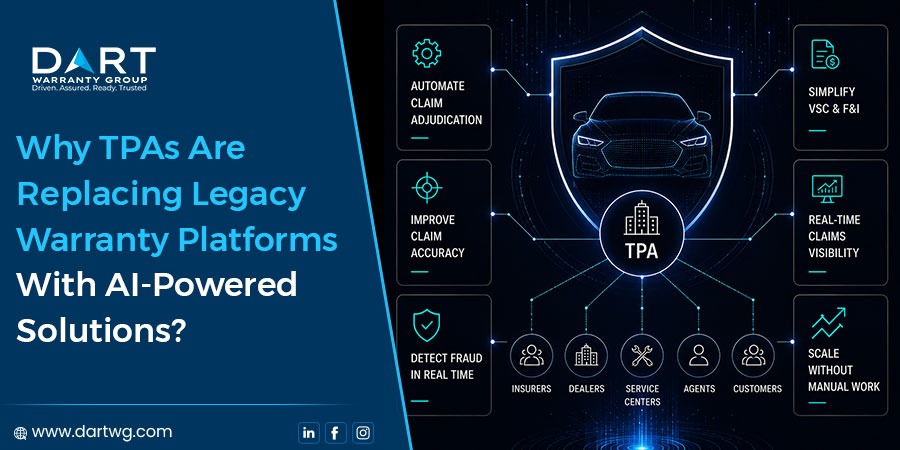
Additionally, this rising demand is driving the use of AI-based auto warranty management software in USA, based on cloud-native technology, predictive analytics, and intelligent automation. Modern platforms are no longer passive data recording tools; instead, they analyze data, give recommendations, automate processes, and help businesses perform better continuously.
Let’s discuss the reasons why traditional systems are getting outdated, the technological challenges associated with them, and how AI-based solutions can help TPAs evolve.
The Digital Transformation of Warranty Administration
There have been many changes in the warranty business in the last ten years. The technologies of vehicles have been developing rapidly; customers’ requirements have become more digital; and there have been significant advancements made in warranties themselves.
Modern third-party administrators do not deal only with refunds. They perform the following responsibilities as well:
- Warranty Contract Management
- Processing Claims
- Permission to fix
- Coordination of dealers
- Communication with customers
- Reconciliation of financials
- Detecting fraud
- Regulatory adherence
- Performance Reports
- SLA (Service Level Agreement) Administration
All of these processes create a huge amount of both structured and unstructured data. Manual processing of such data will be not only more expensive but also less successful in terms of time and quality.
Why Legacy Warranty Platforms Are Turning into Operational Barriers?
Almost every legacy warranty claim management software was developed at a time when the number of claims was lower, and customers would communicate using only phone calls and paperwork.
While these systems have continued to function, they were not built to leverage intelligent automation, cloud computing, and real-time analysis.
Some technical barriers prevent their ability to do so.
Monolithic System Architecture
In legacy warranty claim management software, each business process is integrated in one application in a monolithic way. It makes updates difficult and poses great risks in implementing warranty products or new business rules because of limited scalability and a slow deployment process.
It takes time to update the application rather than making adjustments in accordance with market changes.
Manual Claim Workflows
Traditional methods involve manual verification of customer details, checking warranty validity, analyzing repair invoices, and allocating claims to adjusters by the administrators.
The tedious process of doing all these takes time and leads to errors.
Companies that are using warranty claim management software in Chicago are looking for intelligent workflow automation to avoid doing these tedious jobs.
Fragmented Data Across Multiple Systems
Customer profiles, vehicle history, service information, invoices, warranty agreements, communication within dealerships, and financial data typically reside in disparate systems.
Consequently, claims adjusters spend too much time searching for information instead of assessing the claims.
Disparate data systems make it hard to monitor operations and conduct reporting throughout the enterprise.
Limited Business Intelligence
Analysis applications for legacy systems generally generate static reports that revolve around transactional history.
Although these reports provide operational reports, they do not necessarily cater to future-oriented questions like:
- Which dealers have the biggest warranty bill?
- What vehicle parts are most likely to fail in the next quarter?
- Which repairers have unusual claim behavior?
- What warranty products are going into the red?
Without predictive intelligence, management teams are forced to react after the fact.
The Rising Complexity of Modern Warranty Programs
Warranty administration is no longer about handling mechanical repair claims.
Today’s warranty ecosystem includes:
- Electric vehicle parts
- ADAS (Advanced Driver Assistance Systems)
- Connected vehicle diagnostics
- Subscription assurances
- Extended warranties.
- Telematics service event
- Mobile-first client engagement
All the areas mentioned above contribute to an additional layer of complexity.
With expanding warranty portfolios, conventional systems are not capable of handling the growing number of business rules, integration points, and decisions that need to be made throughout the claims process.
Why TPAs Require Intelligent Decision-Making Instead of Manual Processing?
A critical issue for TPAs includes the increasing number of decisions that need to be made daily.
For every warranty claim, the administrator needs to consider many variables, such as:
- Warranty eligible
- Age of vehicle
- Mileage
- History of repairs
- Terms of service contract
- Coverage of parts
- Estimates of repairs
- Indicators of fraud
- Authorised dealer
This process takes time and causes discrepancies between adjusters.
With the help of modern AI-powered extended auto warranty software in USA, this system has changed, as now adjusters get assistance from smart suggestions through AI, without the need to review everything again from the start.
Rather than replacing human input, AI helps human beings in making decisions.
How AI Is Redefining Warranty Operations?
AI creates a whole new way of doing things for warranty management.
Not only does it learn from pre-defined business rules, but it also continues to learn from the history of warranty information and results.
This allows the system to enhance its decision-making process.
The following technologies contribute to the change:
- Machine Learning
- Natural Language Processing (NLP)
- Intelligent Document Processing
- Optical Character Recognition (OCR)
- Predictive Analytics
- Large Language Models (LLMs)
- Robotic Process Automation (RPA)
- Computer Vision
These technologies collectively allow warranty platforms to automate repetitive work, while making faster and more accurate decisions.
AI-Powered Claim Intake Eliminates Administrative Delays
Initiation of claims can be one of the most time-consuming steps in the process of warranty management. Customers, dealerships, and repair shops provide their invoices, reports, diagnostics, photos, and other documents in various formats.
Traditionally, all such platforms need manual entry of that data by the personnel. However, with the help of modern AI-based platforms, all that information can be automatically entered into the system.
Through the use of OCR and NLP, the platform can automatically detect all the customer details, vehicle information, repair information, validate invoices, and organize the rest of the documentation.
Companies adopting AI claim processing in USA are using these standard features to expedite claim authorization, reduce manual intervention, and enhance overall operational productivity.
AI Creates Smarter Warranty Decisions
Advanced AI algorithms do more than just automate.
They process data from thousands of previous warranty cases to discover underlying correlations among repair operations, vehicle makes and models, maintenance history, dealerships, technicians, and malfunctioning parts.
AI-Enabled Automotive Warranty Software Built for Modern Businesses
Discover More →When a new warranty claim comes in, AI processes these correlations instantly to assess:
- Claim legitimacy
- Expected repair costs
- Missing documentation
- Fraud probability
- Similar historical claims
- Recommended approval actions
- Processing priority
AI does not replace adjusters, but instead provides decision support to process claims more consistently and with more confidence.
Building an AI-First Warranty Platform
Unlike traditional systems, the new-age warranty system is designed on a modular cloud-based platform.
The core components include:
- API Gateway
- AI Inference Engine
- Workflow Automation Layer
- Claims Processing Engine
- Document Intelligence Service
- Data Lake
- Analytics Platform
- Identity & Access Management
- Compliance Monitoring
- Customer Self-Service Portal
This system makes it possible for TPAs to add functionality, connect to third-party services, and increase processing capability without affecting existing processes.
Modern AI Architecture: Designed for Scale, Speed, and Intelligence
Migration to the modern platform goes beyond introducing automation, as it involves building a whole new technology layer. Today’s warranty ecosystems are built based on cloud-native technology, microservices, APIs, and AI algorithms able to process both structured and unstructured data at the same time. The modular nature of such a design means that TPAs can introduce new functionalities without interfering with their current workflows.
In contrast to monoliths, the AI-based platform divides business logic, claim handling, analytics, document understanding, and customer interaction into separate services. The modern ones also come with connectivity to DMS (dealer management system), CRM systems, payment gateways, telematics systems, ERP solutions, and OEM databases. This enables the removal of data silos and the creation of an ecosystem where everyone can work on the same real-time information.
Businesses using AI-powered extended auto warranty software in USA are now increasingly looking for platforms that have an API-first approach and can offer seamless integration, constant AI model training, and high levels of security.
High-Impact AI Use Cases That Are Redefining Warranty Operations
It is not confined to performing mechanical functions; rather, it has come into play in aiding TPAs in making quicker and more educated decisions throughout the warranty cycle.
Smart Claim Prioritization
AI sorts claims by their priority level, taking into account the urgency, the value of the claim, type of warranty, risk, and client information. Priority claims will be handled by seasoned adjusters, while lower-risk claims will run through automated processes.
Prediction of Component Failures
Learning algorithms examine the history of repair records and the history of the manufacturer and predict the failures of specific components before they occur widely.
AI-Powered Customer Support
Instant answers are available to customers’ inquiries about warranties, explanations of the warranties, status updates on claims, and guiding customers through documentation processes. This minimizes the workload in call centers while increasing response time.
Benchmarking of Repair Costs
This tool evaluates estimates by comparing them against historical claims, regional labor costs, and cost of parts before approvals.
Institutions that have adopted AI for their claims processing procedures in USA are utilizing these functions to minimize approval time while maintaining greater consistency and accuracy.
Legacy Platform vs AI-Powered Warranty Platform
The difference between traditional warranty software and AI-powered platforms goes beyond automation. It is a transition from reactive management to smart decision-making. Let’s take a look at the following:
| Capability | Legacy Platform | AI-Powered Platform |
| Claim Intake | Manual | Automated with OCR & NLP |
| Coverage Validation | Rule-based | AI-assisted real-time verification |
| Fraud Detection | Static rules | Predictive anomaly detection |
| Claim Assignment | Manual routing | Intelligent workload balancing |
| Reporting | Historical reports | Real-time dashboards and predictive insights |
| Scalability | Limited | Cloud-native and elastic |
| Customer Support | Agent-dependent | AI chatbots and virtual assistants |
| System Updates | Complex upgrades | Continuous deployment |
| Decision Support | Minimal | AI recommendations and risk scoring |
This transformation also allows TPAs to be more flexible and less hampered by the operational obstacles that are common in legacy environments.
Evaluation of the Business Impact of AI Acceptance
Technology investments are determined based on business results. Moreover, AI-driven warranty systems provide benefits in various functional areas through increased efficiency, better decisions, and reduced manual labor.
Some of the benefits claimed by many companies include:
- Faster claims processing
- Lower administrative costs
- Increased accuracy in fraud detection
- More frequent initial approval
- Improved SLA compliance
- Higher customer satisfaction
- Fewer operational risks
- Enhanced scalability in high peak claim periods
In light of the rising claims volumes, such efficiency measures become necessary to ensure profitability and consistency in service delivery.
Companies implementing the auto warranty management software in USA are starting to see AI as more than just an added feature but a key investment in future business growth.
How Chicago TPAs Are Reforming Warranty Technology?
In recent years, Chicago has emerged as a hub for the development of innovations in the field of automotive services, insurance technology, and enterprise software. TPAs functioning within such a competitive space face permanent challenges to improve efficiency and manage ever-more-complex warranty systems.
The rising popularity of electric automobiles, connected vehicles, extended warranty options, and digital services channels makes organizations require intelligent warranty systems able to process large volumes of claims efficiently.
By deploying warranty claim management software in Chicago, companies rely on AI technologies to collaborate better with dealers, approve claims faster, prevent fraud, and create superior experiences for their customers without additional expenses.
This trend in Chicago is consistent with a wider trend as digitalization becomes necessary for staying competitive in the warranty industry.
Key Considerations When Looking for an AI Warranty Platform
However, not all solutions powered by artificial intelligence are created the same way. Because TPAs looking at new platforms should prefer solutions that scale, rather than automate on a short-term basis.
Important aspects of the platform include:
- Cloud-native deployment
- API-first architecture
- Intelligent document processing
- Explainable AI recommendations
- Configurable business rules
- Real-time analytics dashboards
- Multi-tenant support
- Enterprise-grade cybersecurity
- Compliance monitoring
- Continuous AI model improvement
Choosing a platform with these aspects helps companies cope with changing warranty offerings, regulation, and customer demands.
The Future of AI in Warranty Management
AI in the warranty management software of the future will do more than automate workflows; it will enable autonomous decision-making.
The technologies that are developing in this area are as follows:
- Agentic AI capable of managing complete claim workflows
- Generative AI for automated claim summaries and correspondence
- Computer vision for vehicle damage assessment
- IoT-enabled predictive warranty servicing
- Digital twins for monitoring component performance
- AI copilots that assist adjusters during complex claim evaluations
- Real-time warranty pricing optimization
- Predictive reserve estimation
- Intelligent compliance monitoring
As these technologies become mature, TPAs will have more reason to shift from the conventional manual approach towards more intelligent warranty ecosystems.
Companies that are leveraging the power of AI in warranty management software in USA will be able to cope with these changes effectively.
Final Thoughts
The industry of warranty services is approaching a new era in which speed, intelligence, and scalability will determine success. The old systems developed to serve the needs of the previous era of warranty management cannot cope with the current challenges faced by today’s TPAs, such as large amounts of claims, changing vehicle technologies, increased compliance, and customer service standards.
With the help of an intelligent platform, all those problems can be solved thanks to intelligent automation, analytics, cloud-native development, and real-time decision support embedded into one ecosystem. Instead of the digitization of legacy processes, these systems redefine how warranty management is done through the process of claims intake, fraud prevention, customer communication, and performance analysis.
For TPAs looking to grow and optimize their operations, it is no longer only about implementing a new system; it is also a question of their business strategy. By implementing new AI-based warranty management, an organization ensures its future success.
Also Read: AI Is Rewriting Claims Administration. Is Your Warranty Platform Already Obsolete?
Frequently Asked Questions
1. Why do TPA’s need to shift from old warranty platforms?
The old warranty platform is dependent on manual processes and non-integrated data. AI-based systems offer automation, predictive capabilities, fast claims adjudication, and scalability, thus making them ideal for today’s warranty operations.
2. How does AI help with warranty claim management?
The technology helps automate document verification, verify coverage eligibility, prioritize claims, detect fraud, predict repair outcomes, and offer real-time suggestions.
3. What features should modern warranty management software possess?
They should include cloud-native capabilities, API integration, AI-powered analytics, intelligent document management, fraud detection, customizable workflows, cybersecurity, and real-time reporting.
4. Why do TPA’s need AI in automotive warranties?
AI assists TPAs in saving manual effort, providing consistent claims, detecting any fraudulent activities, cutting operational expenses, and giving quick customer support along with growing warranty portfolios.
5. How does AI benefit TPAs in Chicago with warranty management?
TPAs in Chicago use AI for efficient claim processing, better collaboration with dealerships, improved fraud protection, and scalable warranty programs.
6. What is the future of AI in warranty management?
AI in future platforms will include Agentic AI, Generative AI, computer vision, predictive maintenance, IoT integration, and autonomous claim processing.
Leave a Reply
Recent Posts




Daniel Kozlowski
Designation: Co-Founder
With over 30 years of experience in the extended warranty and service contract industry, I help businesses modernize warranty operations and optimize claims management processes. As the founder of DRK Resources Tech LLC, I share insights focused on warranty management, service contract solutions, and automotive technology trends.